We found ourselves with the weekend off, and we definitely wanted to do something on our list. When we are staying in a new area for awhile I make a list of all the places I would like to see, and when we have time we can choose from the list. During the research process I was really surprised to find that Walnut Grove (the town from Little House on the Prairie) was 1-1/2 hours away. I had read the books as a child, but was much more into the TV show and I had a vague notion it was in Kansas. It turns out it was in southern Minnesota and when I saw that the museum was reopening from COVID closure that weekend I knew we have to go. Thankfully Lee, who is always a good sport about these kinds of things, was game so off we went. While we were driving I checked the Roadside America app and looked for places to stop along the way. I have always been a huge fan of the app, but I was pleasantly surprised by how COVID friendly it is. Most of the stops are outdoors and here are a few places we jumped out and took pictures of along the route. This was very rural country by the way, and the app had plenty to see.
Giant bell
Cool fireman statue
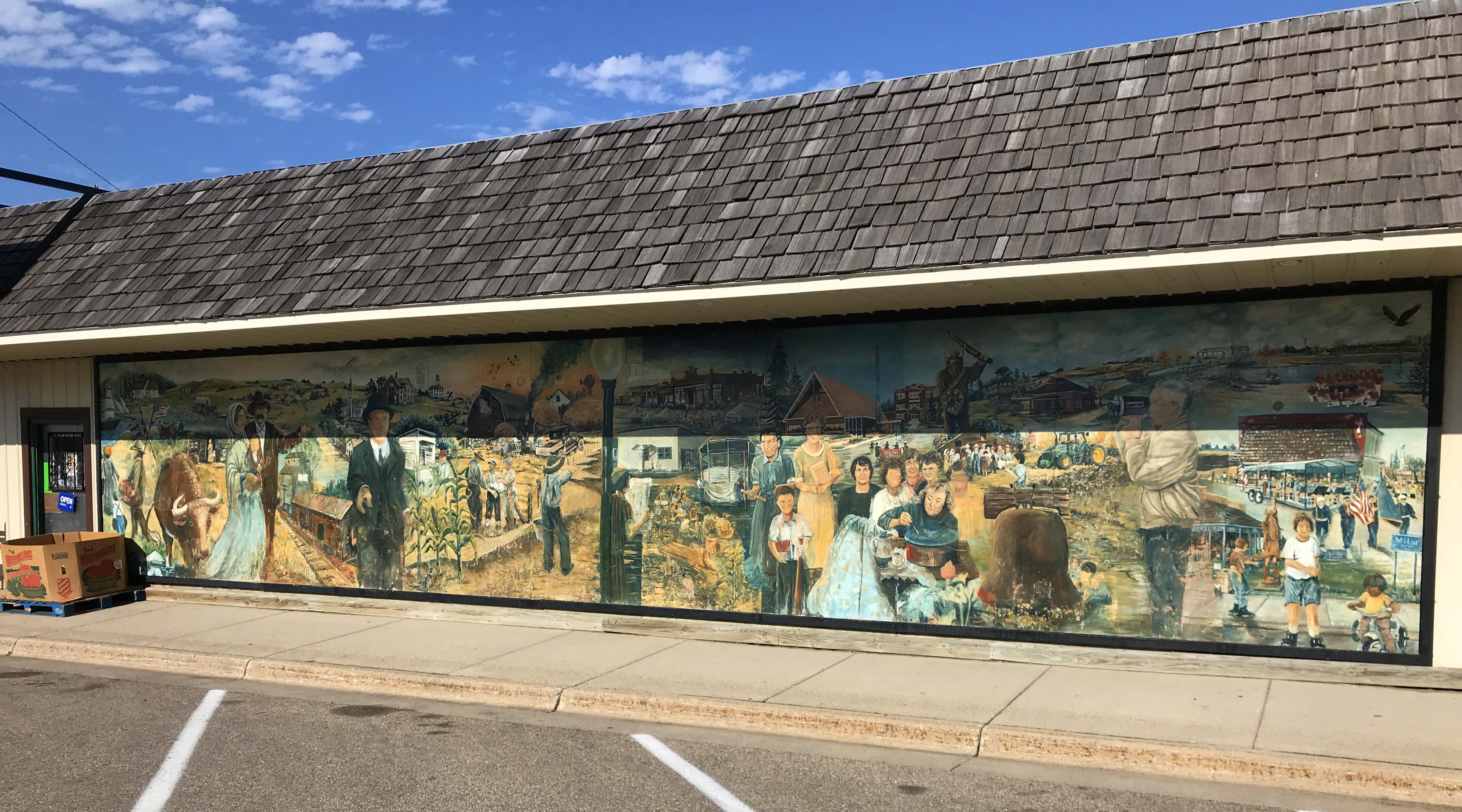
Lovely mural
Giant wooden viking
And my personal favorite the “Worlds Oldest Rock”
Finally we made it to the site of the homestead and cheerfully paid our $5 to enter the property. As we travel we have seen several places that are on private property that the owners make available to the public. I never mind paying them a small maintenance fee and am always grateful that they allow folks to visit. Fair warning this place is not big rig friendly, so I would definitely recommend going with just your vehicle.
We turned down a long country road
Saw a beautiful little farm
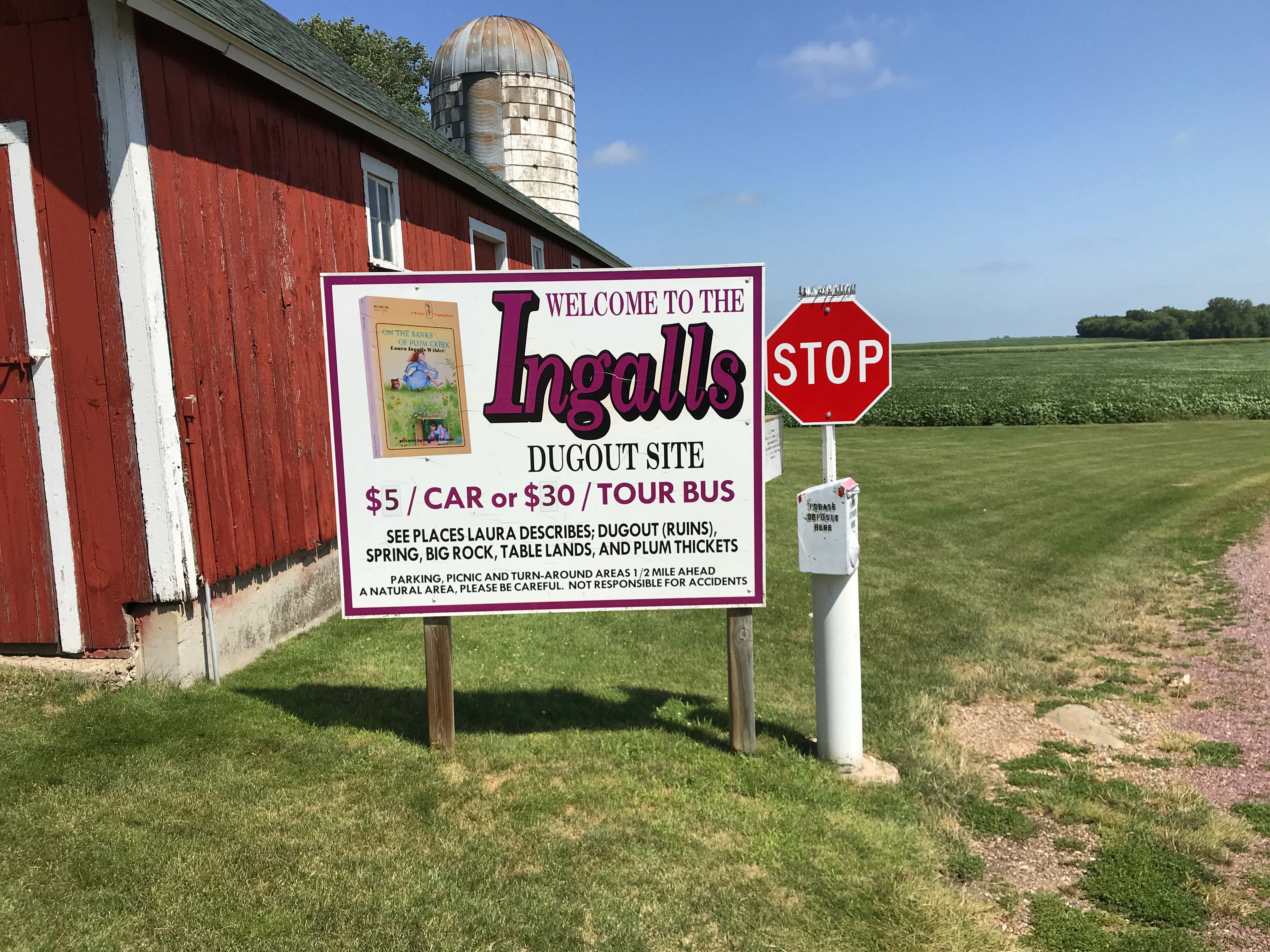
And then saw this sign. Bring a $5 bill. And even though it says “tour bus” it’s NOT big rig friendly.
I should probably stop at this point and give a little background. If you have read the books you know there were major differences between them and the TV show. On the banks of Plum Creek has most of the story we remember fondly and this was the land they owned during that time period. They actually moved several times during her childhood as this map shows.
Although I wasn’t 100% sure what to expect I will admit I got goosebumps when we saw the creek. It may have changed its path since she lived there, but it was still the same body of water.
The road ends in this small parking circle, with the creek to the right. As you can see, there’s plenty of parking, but all it takes is a few vehicles and suddenly there’s no room to turn a rig around.
Plum Creek
The signage isn’t great when you get there, but go to the right to see the creek and to the left is a bridge that takes you to the former dugout location. Since the one other person went left, we went right and came upon what might have been the “big rock.” In the book Laura talks a lot about the big rock and this was the only one they could find left on the property. It probably isn’t the same one, but it was still fun and I definitely had to take a picture on it.
\
As you can see from the smile I felt like a little kid again. That in itself was worth the $5 🙂
To the left was a nice wooden bridge and the dugout site. It was very common for farmers to live in a dugout until the first crop came in and they used the proceeds to build a house. They had plenty of wood, but nails and other things cost money and they didn’t want to invest until they were sure the land would yield.
View of the creek from the bridge
They planted the area around the site with traditional plants that would have existed at that time and only cut a walking path which was pretty cool. This view definitely made me think of Laura skipping through the meadow.
The homestead site itself I need to say is not particularly glamorous. If you have no sentimental attachment to the books, save your money because all you will see is a hole in the ground. I saw a little piece of history and was particularly impressed by how small it was. Of course this is what the dugout hole looks like after over 100 years of being flattened by rain and wind and time, which eventually erases everything.
It was hard for me to picture though so I was glad when later we went to the museum and they had a recreation. I’ll show that here, but remember this is only at the museum.
I had three girls also and I am trying to imagine raising them in this
Two of the interior walls looked like this
We didn’t spend long at the homestead site because it was so hot, but drove into town and saw the museum. The gift shop is free, and it was a super nice one, and touring the museum area was only $2 a person. The smaller buildings were closed because of COVID but it was still worth it especially the room where they had lots of memorabilia from the TV show. Over the years many of the actors from the show have visited this small town and the pictures and stories really brought back a ton of memories.
Awesome gift shop
Ma and Pa
Mary’s story was interesting because in the TV Show she got married but not in real life
Laura did not start writing these books until late in her life, which I didn’t know either
My favorite character was Nellie. There was something about the spoiled brat turning into a nice woman that was really compelling. The actress who played her has visited the area many times and is a local favorite.
I loved this buffalo coat
And an entire outfit worn by the Doc in the TV Show
But the absolute best was Pa’s fiddle from the TV show which gave me chills
After we walked around, we were both hungry and I was thrilled to see a sign for Nellie’s cafe in town. We haven’t eaten inside a restaurant since COVID started, but since it was small and only held 23 people we felt it was worth the risk. We ate at the counter and the owner was really great. The food was also yummy, Lee loved his Frisco burger, onion rings, and of course a piece of home made pie.
I even bought a $12 T-Shirt
Carol the owner runs a tight ship and we highly recommend stopping there is you are in the area.
One thing that really was interesting about this visit was when I posted it on Facebook I heard from so many people my age who were jealous! Several people I knew also reached out and said they had been there which really surprised me because you have to go to some trouble to get to the town. Again if you are not a fan I don’t know that it was worth it, but if you are it was more than worth the time and money spent. For us as our first full day out exploring since Covid, it was darn near perfect.
Next up we decided to stop in Tracy, Minnesota and stumbled across a really cool Train Museum!
Supporting our Blog
We very much appreciate your support of our blog.
You can purchase the ebook telling the story of how we became full-time RVers.
You can purchase our recipe book filled with 80 recipes we have cooked in our RV and taste tested by Lee himself. You can purchase the kindle or paperbackversion on Amazonor buy the Apple version on iTunes.
When Lee started looking for a job in June, he wanted to find something that didn’t deal directly with the public and mostly had weekends off. I did some research for him and gave him multiple options, but he selected working at a small airport mixing chemicals and fueling crop dusting planes. The job was in Minnesota (near our daughter), did not involve the public at all, and paid $15 an hour. It also had weekends off although during the “busy season” he knew he would be working long hours and some weekends.
It sounded fine to me and we headed that way, ultimately arriving in Appleton, MN. We received several phone calls along the way to make sure we were en route, and when we finally arrived at the campground the owner of the company came right over to meet us. We were thrilled with our site at the campground and happy to be in one place for awhile. The owner of the company told us that in previous years he had always hired college students, but when he lost several to graduation this year he decided to try work kampers.
Dealing with adults rather than college kids is certainly different, but he seemed open to the concept of work kampers and Lee and I both got a really good vibe from him. Lee and I spent the next day getting oriented to the area (grocery store, hardware store etc) and then Monday morning Lee started working. Below is an account of how the first few days went. As always, keep in mind experiences vary from person to person, so I will try to state things as factually as possible. Value judgement as presented are Lee’s alone and may not mirror someone else’s experiences.
An Air Tractor crop duster.
Day 1 – The first day Lee went into work, he was pleased that the office was large and well kept and the kitchen/break area was well stocked. Everything was pretty new and nice and clean and tidy. The airport is only 1-1/2 miles from our campground, but since the schedule is variable we knew Lee would not always get home at the same time. Thankfully our neighbor was also work kamping along with Lee, and since he had access to an extra vehicle from the company he was able to give Lee a ride each morning so I could have use of our truck. The first day started at 8am and since it rained and the planes couldn’t run much, Lee and the other new guy mainly learned the mixing and pumping systems and practiced mixing chemicals using colored water.
The job is essentially to mix specific types of chemicals (based on individual farmers work orders) and then pump those chemicals into the planes when they came into the hangar. The planes also need fueled and windshields cleaned, etc. Because this is a fast paced business, it is a little like NASCAR where the “pit crew” gets the plane out as quickly as possible. Unfortunately the process is not simple and there was definitely stumbling the first day. There was some pressure to go faster, even in a practice environment, but Lee held firm that accuracy was more important than speed that first day. (I believe that it’s better to teach muscle memory correctly then build to speed rather than force speed and learn bad habits. Efficiency is both an art and a science. And I’m also deeply suspicious of any environment that creates artificial urgency and stress, especially for new people, as it benefits nobody and nothing. – Lee)
The environment is also no joke as these planes have live propellers that don’t stop spinning when they come into the hangar, and the chemicals being mixed and pumped are pesticides and fungicides and are extremely toxic. A mistake costs not only time and money, but could also result in a serious injury. When Lee came home at 5pm that first day he really wasn’t sure what to think. He found the work itself interesting, but was having a hard time getting the process. This was partly due to haphazard training and inconsistent instructions, but it was also due to the level of complexity, and Lee hoped the next day would be better in a live environment. At the end of the day he was told to return the next day at 8am. (Again, I am always very concerned when there is no documentation or formal training for a job. That says a LOT about the environment immediately. People put time and money into what they care about, and the opposite is also true. Something this complex and dangerous should have ample safety and other training. “Don’t get that stuff on you” is not training. Being taught y someone who arrived two months before you who is ALSO a work-kamper just leads to middle-man syndrome. But I also chalked most of the chaos up to the fact that the owner was used to working with college kids instead of adults (not sure why I thought that mattered) – Lee)
Boom with spray nozzles
Day 2 – The second day it stopped raining and Lee knew it would be for real. It was a bit of a stumbling effort getting into the pattern of filling the planes for real, and there was definitely more pressure to do it quickly. Around 5:30pm Lee was told the crew was working until dark and one of the employees gave him a ham and cheese sandwich. Lee knew that they would eventually be going long days but didn’t expect it to start immediately, on his second day, so he didn’t bring lunch and dinner. Plus he didn’t have any goggles and by the end of the day his eyes were burning. Whether that was from jet fuel exhaust or chemicals he didn’t know but when he finally got home at 9:30pm he reeked of something and his eyes were red and watery. As tired as he was I made him take a shower before he came to bed, mainly because I didn’t want that stuff on his skin. He was told before he left that they were starting the next day at 6am and we scrambled to figure out what food he could take that would work for the whole day. Again he wasn’t sure how he felt about it. There was lots of down time in between planes, but the lack of a plan and the physical impact were getting to him. (For me, this level of ambiguity in scheduling is a problem. To go from “It will be M-F during the day” to “It will be any time between dawn and nightfall plus weekends” is a pretty big jump. the jet fuel fumes were definitely a problem, and I was really unhappy that no goggles or respirator mask were provided. Again, these small things tell a lot about how an organization is run and what the priorities are. Someone who has been doing something for 40 years already knows that people should have masks and goggles. They’re not missing because of oversight. I specifically asked if personal protective equipment would be available in the phone interview, and was told that it would all be provided. – Lee)
“Cones” used for mixing chemicals
Day 3 – The third day he got up at 4:45 and was out the door at 5:45am. On one of my breaks in the morning I went to the local hardware store and bought the last pair of goggles. Lee needed something to completely cover his eyes and by the time I got him the goggles he already had an abrasion of some kind. It could have been a piece of metal, or grit, or really anything and I was glad I was able to get him the goggles for future protection. The work was much easier on the third day though and they were turning planes in 4-6 minutes, which seems pretty fast for brand new people. Because only two planes are running currently they generally had a 20 minute break between planes. This will change as more pilots are added, but for now the pace was manageable. Unfortunately today was the day we learned that he would normally be working split shifts when they sent the crew home around 1pm. Turns out the wind kicks up almost every day between 1pm and 5pm so most days they leave and come back and work 5pm until dark. The problem was Lee was expecting to work long days and because he would be making overtime it was worth it. Now he learned that the long days would not all be paid and he was “on call” during his down time. Personally I had a big problem with that because it was definitely not communicated to us prior to him taking the job and it left us both wondering what other piece of news would happen next. Still he decided to continue to work it out and see what came next. (This is a really big deal to me. A split shift is unpleasant and is the sort of thing, again, that should have been clearly communicated on the phone. Starting a day at 6am and working until 9:30pm with a break of unknown length in the middle makes for a VERY long day and if you’re not the napping type, which I’m not, you get tired pretty fast. – Lee)
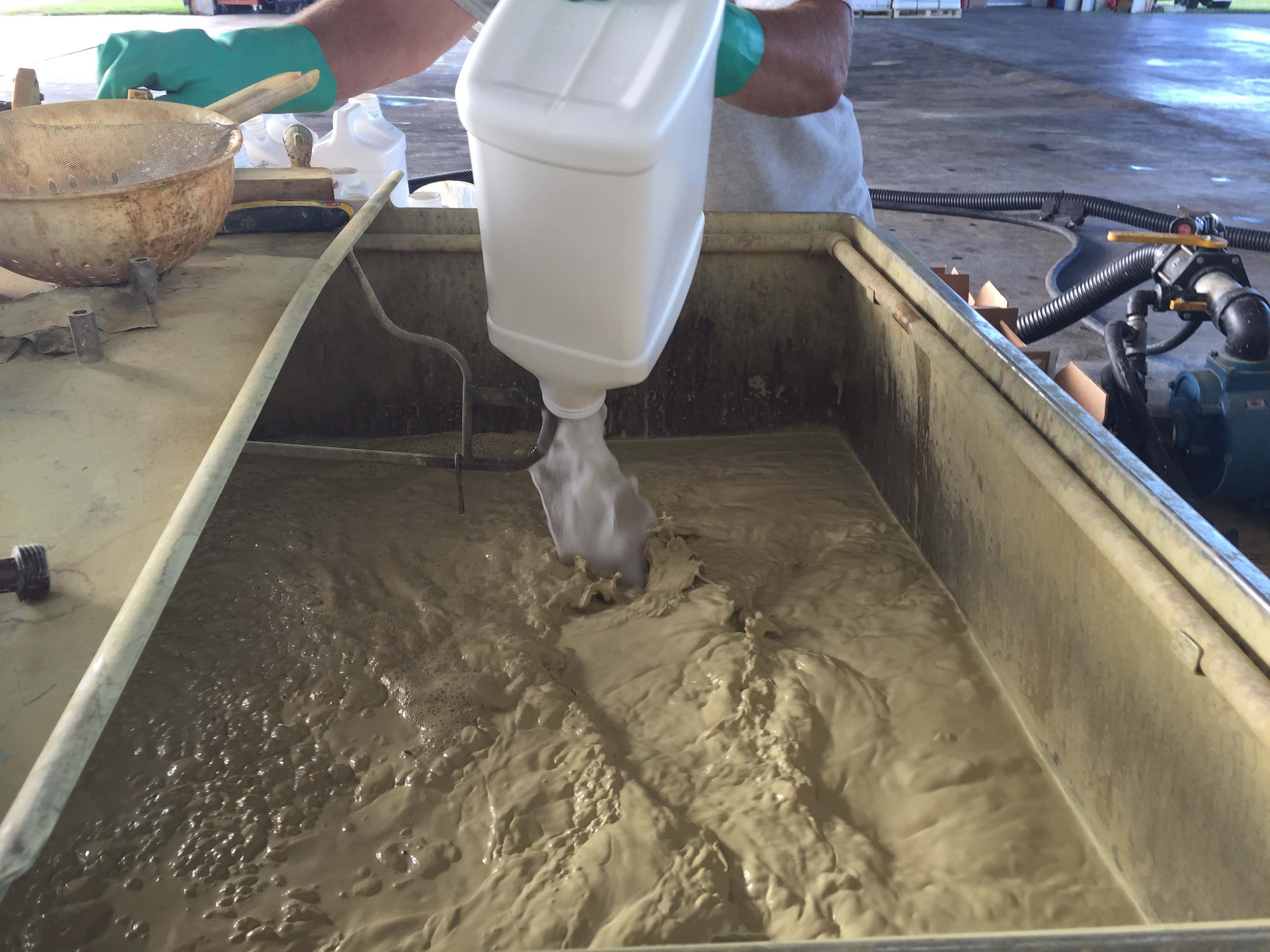
Mixing chemicals in another vat mixer.
Day 4 – Once again Lee got up early and was onsite by 6am but this time he was prepared. He had lots of food, was prepared for a long day, and the break that would probably come early in the day. By 8:30 though the wind was strong and there was thunder and some rain. Based on what had happened the previous day I expected Lee to come home, but instead they kept working. The “work” consisted of following the owner around for 2-1/2 hours and having him talk about his plans, but nothing else really happened. To be clear at this point the work itself was completely fine with Lee but the arbitrary nature of the schedule was tough. He understood that the weather dictated what they could do but the work was also based on how the owner was feeling that day. To be fair this is pretty common in most small businesses, but most employees also have set hours and some level of job description. Different people have different levels of job flexibility, but I think most people appreciate some kind of structure to work in. Again, your mileage may vary on that, but the lack of structure seems to be a common theme with these seasonal jobs. Lee ultimately had to go back in at 5:00 pm but was let go again at 8:00 pm.
Fueling and pumping in chemicals
Day 5 – Lee started the morning again and they worked until noon. At that point Lee was trying to get a feel for what was happening over the weekend, but not surprisingly no one wanted to commit. When they ran out of work orders at noon, Lee really pressed the issue. Finally the owner said they weren’t working the weekend and Lee left for the day around 12:30. For the entire week he ended up with 40 hours RT and 8 hours OT which seems great, but he was essentially on call from 6:00am to 9:00 pm for three of five days. Keep in mind on call means on call. No driving far away, no drinking, and no getting into anything that you couldn’t easily get out of. Lee did manage to go to Walmart one day, but that was only a 25 mile drive and it was raining when he left.
So what do we think so far? Well, the owner was definitely not transparent about the downsides of the job, but Lee also didn’t ask the right questions. Since the owner has only had college kids in the past he may not have known the types of questions we would ask, but I find it hard to believe that he wouldn’t think the split shifts would be a big deal. From Lee’s perspective the long hours are fine (since he gets OT) but the stop and start nature of the work coupled with the long window he needs to be available is problematic.
He likes the work itself although there have been several potential safety issues. To be fair the owner has largely addressed those as they were brought up, but since he has been doing this for a long time it is surprising they exist. Again college kids might not notice or say anything, but an older person with grand kids and a wife would feel differently. $830 gross per week is not a bad check, but there are limits to what we would do for that kind of money.
Supporting our Blog
We very much appreciate your support of our blog.
You can purchase the ebook telling the story of how we became full-time RVers.
You can purchase our recipe book filled with 80 recipes we have cooked in our RV and taste tested by Lee himself. You can purchase the kindle or paperbackversion on Amazonor buy the Apple version on iTunes.
This is a pretty long post about not just the discount fuel program, but also about fueling at truck stops in general. There’s lots of information for people who love the details, like me. If you don’t want all that stuff, here’s the New York City version: I’m going to tell you how to save a TON of money buying fuel for your rig. A TON. So get a cup of coffee and enjoy.
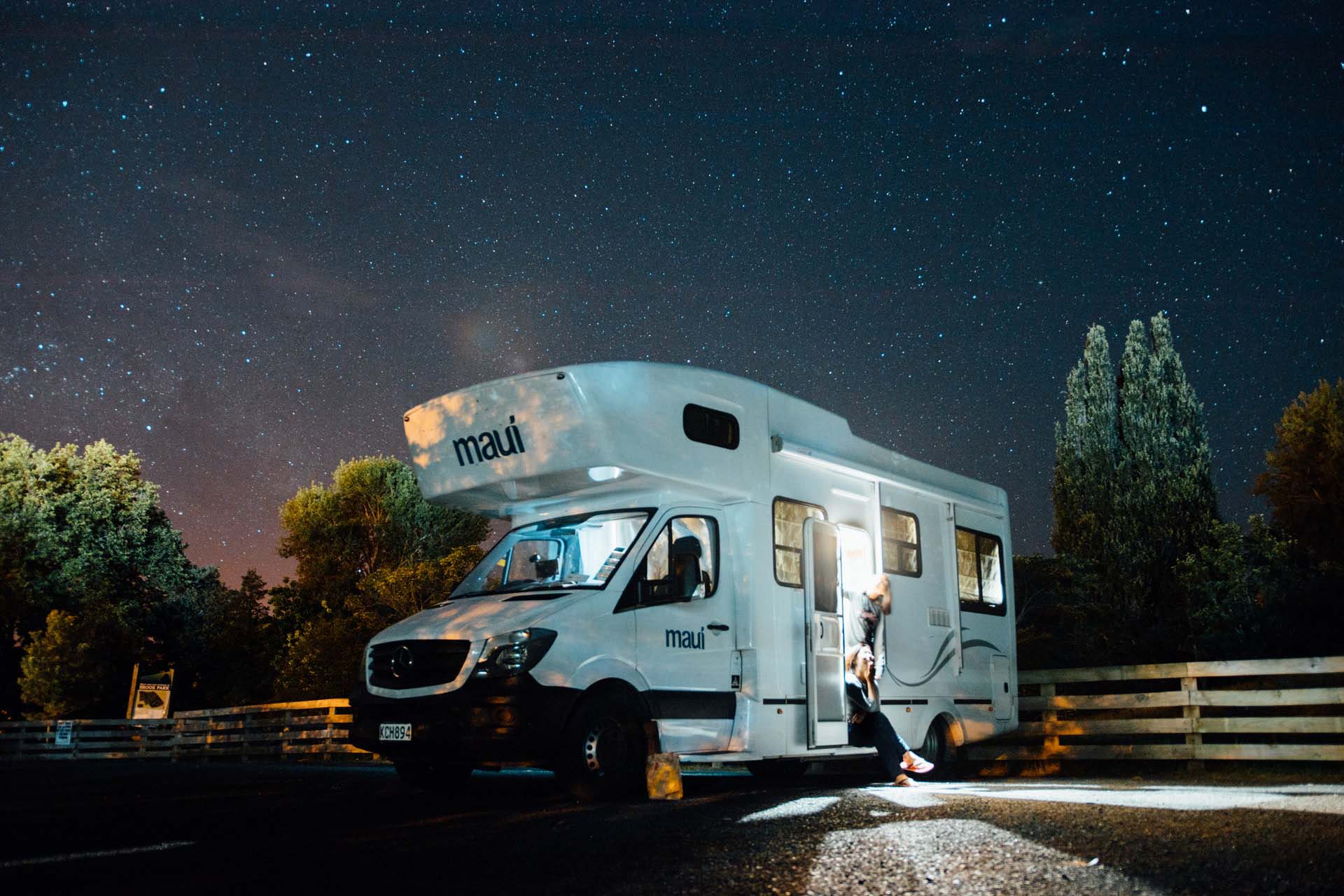
This is only a matchbox type camper, and doesn’t really use fuel, but it’s a great picture, and some people like the blog just for the pictures. Later there will be pictures of pigs, for people who like bacon.
Since we recently started traveling again, after sitting for six months, we started thinking about the costs normally associated with travel, such as campground fees, and fuel. Normally diesel is more expensive than gas, sometimes by quite a bit. We’re not the only ones who worry about this. Every rig burns fuel, whether you’re in a modified matchbox van or the largest and most expensive class A bus.
Look at all those stars. While you’re driving around living your life, you’re going to save money equal to the number of those stars. (If you burn enough fuel.)
Because fuel is one of the major costs in this lifestyle, we are always on the lookout for cheaper ways to fuel up when we travel. Normally this topic might be considered boring by most people, but what if I told you that you could be saving up to fifty cents per gallon, and sometimes even more, whenever you fuel up? Would that be boring?
Get ready to bring home the bacon!!! It might seem like a small amount of money, but just watch. It grows, trust me.
TSD Logistics offers RVrs access to their fuel program, and the savings are pretty spectacular. Before I go any further, I want to stress that this is NOT a credit card. It is NOT a membership program. It is NOT for gas. It is for diesel fuel ONLY, so if you do not purchase diesel, then you can stop reading here. Or, you can keep going so you can tell all your diesel buying friends about it! In addition to the savings on fuel, you can get up to $200 in cash per week (just like using an ATM) but there are no fees, so it’s cheaper than using most ATMs. And a further bonus, you can also use the card to purchase DEF in truck lanes that offer it, although there will be little or no discount for the DEF. Still a nice convenience for anyone who uses the DEF pump. (And if you don’t, you should try it, it’s much better than pouring the DEF in from a box or jug).
TSD Logistics is a bulk transport freight company that has been around since 1980, so they’re firmly established and stable, and will likely be around for a long time. Their primary work is as a carrier of the tire and rubber industry’s raw materials, including silica and carbon black. They invented some of the trailers and hoppers in common use today. Headquartered in Texarkana, TX, but operating throughout the US, they are able to negotiate some pretty impressive discounts on diesel fuel. (To be clear we are in no way associated with this company and are not being directly compensated to write this post. I should probably also state here that this is based solely on our experience and opinions. We always try to give good advice, but as always your mileage may vary. – Tracy)
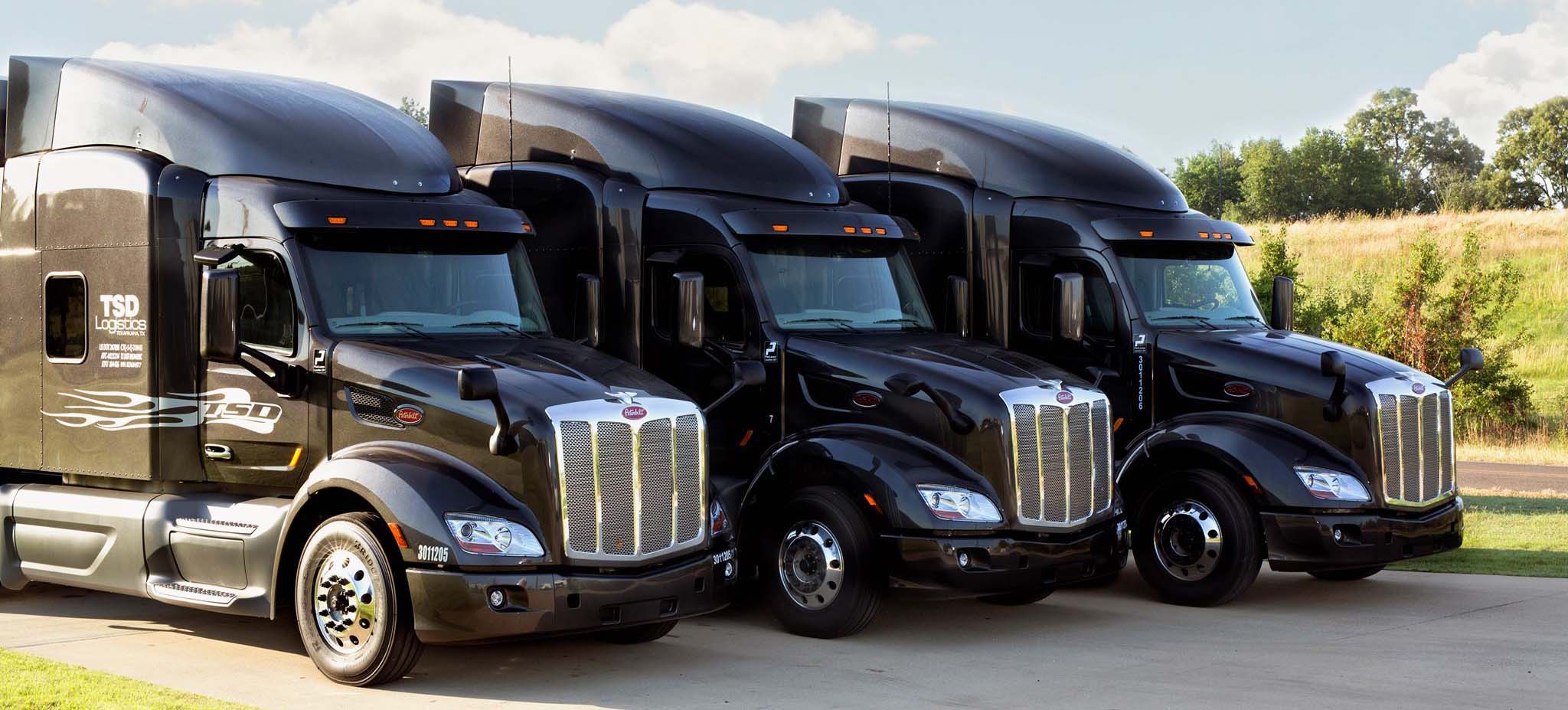
TSD Logistics, where the trucks are as sexy as the diesel discounts!
The discounts are then made available to anyone who wants to sign up for their fuel card, which is through the Wex EFS system.
Once you have applied for and received the card, using it is relatively simple, with a few minor caveats. I will talk about those, and go into more detail about each step, but here’s how easy it is:
Pull your rig into a truck lane at a truck or fuel stop that is part of the discount program.
Insert or swipe the card at the pump.
Answer the questions on the screen like you would at any pump.
Pump your fuel (and DEF if available and needed)
Details regarding your transaction, including the discount and fees show up in the app usually within a few minutes.
Within 2-5 business days the money is drafted from your bank account and you receive an email showing you the details of the transaction and the TSD fees.
Rinse, and repeat, and let the savings pile up!
You’re gonna be rich! Well, not rich, but less poor than you are now.
I already mentioned this before, but it’s very important, so I will mention it again. This program is an extension of a trucking company, using their buying power to get you the “pro” price for diesel. So it’s not for gas.Diesel only. Look for green, although green doesn’t ALWAYS mean diesel. If you don’t see a sign that says DIESEL, or a diesel price, keep on going.
I would absolutely fuel here.
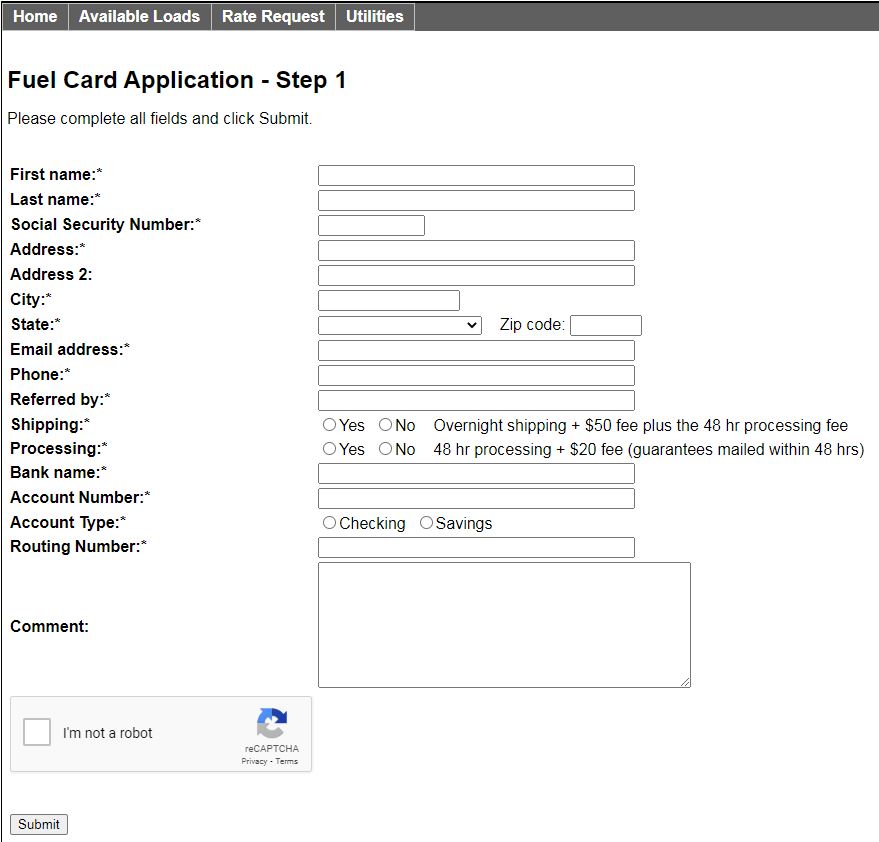
As I mentioned before, it’s NOT a credit card, it behaves more like a debit card. You use it instead of your debit card, but it’s connected to your checking or savings account. Then any money you spend is deducted from your checking account in a day or so, just like a debit card. (Some people open a secondary checking or savings account only for use with this program, because they are concerned about giving out their checking account information. If that’s something you want to do, you certainly can. Just be sure there are funds in any account associated with the card; they charge a $15 fee for insufficient funds.) To start with, if you want to attach this card to a separate checking or savings account, you’ll need to open one. Then you can either click HERE, or go to this address to apply for the card: https://tsdv.loadtracking.com:8443/im/fuelcardapp
“Apply” isn’t really the right word, you’re really just signing up. There’s no credit check, and I can’t think of a reason why they would reject anyone. They do ask for a social security number to protect them from people who sign up and buy fuel with an empty account. Here’s what the form you will fill out looks like:
As participants in the program, we get a small fuel credit for each person who signs up and uses the card, so if you do decide to get a card, please consider putting “Lee Perkins” in the Referred By field! Once you get the card, you can start using it immediately. (Although we are not being paid to promote this company we would receive a one-time $25 fuel credit once a new customer spends buys 100 gallons of fuel. Hopefully you know us well enough by now that we would NEVER recommend a company unless we believed in it. A little bit of free fuel is always a good thing though so we will certainly take it if you decide to use our names and use the program. If you have concerns please skip referring us, but we still recommend you try it out. There is no upfront cost, and if it doesn’t work for you we can’t think of any downsides to having the option. – Trace)
Since we started full timing, we have always preferred truck stops to gas stations, and truck lanes to car or RV lanes when we are hitched up. There are a lot of reasons for this. We got a Good Sam Pilot/Flying J credit card because that’s the brand I prefer, and we get a $0.08 discount off the cash price, which typically brings the Flying J/Pilot price down to match the rest of the chains. So I got to use the place I prefer, and not pay a premium for it. Truck stops are everywhere; they’re right at the exits, they are generally very easy to get in and out of and they generally have plenty of room to maneuver and park. Some of them are just massive places! They are designed for big rigs, all of which are bigger in every way than any RV.
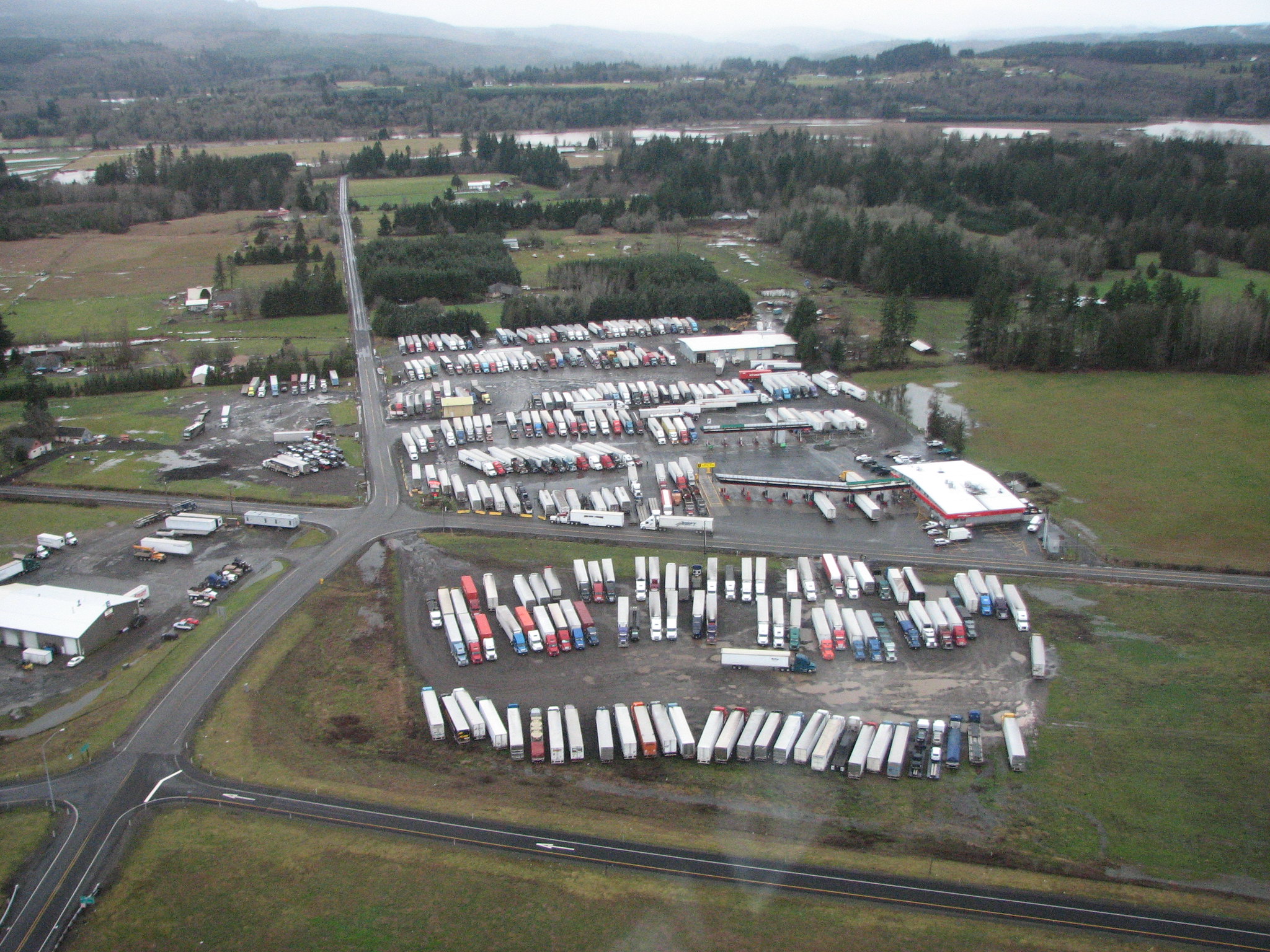
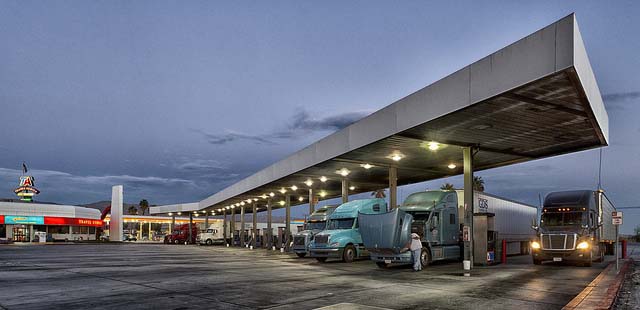
Look at the size of this place!!
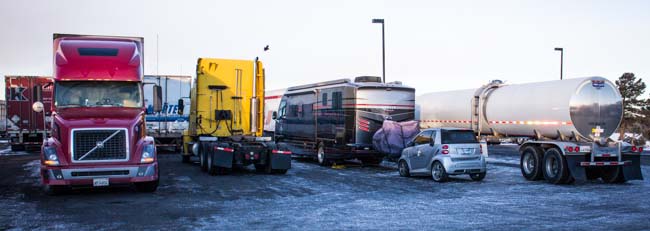
Plus, fresh diesel is better than stale diesel, and these places move a LOT of fuel. There’s also no transaction limit. Lots of gas stations have $100 per card or per day limits, and large class A motorhomes can easily take that much fuel. As can many large pickups with auxiliary tanks. Most of the major chains have locations that are sized based on how busy they are, so you can see centers with 20 or more truck lanes. The pumps are also high volume, so it doesn’t take long at all to fuel, usually less than half the time of a standard pump. The caveat to that is if you have a pickup truck, make sure it has the large nozzle hole. Not all of them do. And as mentioned before, most now have DEF pumps at the truck lanes. Most larger chains have pretty well stocked convenience stores, and food options. Of course, all of these benefits usually mean the cost of fuel is a little higher, but that’s why we only use them when traveling.
The slightly higher price is worth it to us to not have to hassle with going miles away from the interstate and negotiating in and out of a tiny and possibly busy or closed gas station. And now, we can get all of those benefits AND spend less in most cases than local gas stations. We use the Gas Buddy app to find fuel prices when we’re not hitched, and many times the TSD discount price is lower than places like Wal Mart and others. When we’re hitched we use a variety of apps to find truck stops, mostly Truck Stops Pro. When we last traveled any considerable distance, a few weeks ago from San Antonio to western Minnesota, without fail the TSD discounted price at every location was lower at every major chain, and at tiny “mom and pop” type truck stops the price was the same as the cash price at those locations.
An unscientific collection of data has shown us that generally speaking, those small private truck stops are usually a little more rough around the edges, and the price is usually the same as “in town” gas stations. No frills, no extra markup on diesel. This is important to remember when I get to how TSD makes their money on your purchases. (For me this was the major downside of using the program. Flying J’s and Pilots are pretty consistent, but we were exploring new territory by using smaller truck stops. They were a real mixed bag. Some were really nice and clean and others not so great. This matters mostly for me because I try to walk the dog at every stop. I will say that some Pilots and Flying J’s are not that clean either. They are very consistent on the products they stock though. Mainly I am looking at this as a bit of an adventure and am trying to be more flexible. If you are super routine oriented around your stops this might not be the best choice for you. – Trace)
Just look at all those nice big empty lanes!!!
So, if you already are used to using truck lanes at truck stops, saving a bunch of money is going to be yet another benefit for you. If you haven’t done it, there’s genuinely nothing to be afraid of. You should give it a try whether you get this card or not, or while you wait for the card. Here are some basics to be aware of before you decide to give it a try. This isn’t everything, and if anyone comments things I have left out, I will update the post with them.
You are absolutely allowed to use truck lanes in a truck stop to fuel any RV or a pickup with or without a trailer hitched. These places are businesses, who want to make money, and your money is just as good as anyone else’s. Don’t be shy. Get on in there and stimulate the economy. If anyone ever tells you otherwise, smile and nod and tell them you’re on vacation from the Northern Mariana Islands. That’s a US territory, so they won’t hassle you for being a “foreigner”. If they ask why you don’t have an island tan, tell them you just got out of prison. Pull out a map and ask them for directions to the Grand Canyon. They’ll leave you alone.
The entrance is almost always separate from the car entrance. They are also usually HUGE entrances. Whenever possible, until you get the hang of them, try having your co-pilot look the location up on Google earth and spot the truck canopy. It’s usually in the back, and long and narrow. Then have them back track looking for the entrance. It’s usually like a service road, and in busier areas it can have it’s own traffic light. And usually, the car lanes and truck lanes are on opposite sides of the main building, and usually you cannot get from one to the other unless you go back out to the road and come back in. This is to keep cars from getting into the truck area.
Take your time. Go slow. Turn wide whenever you can. Pay attention to the layout and how trucks are parked and moving around. There’s almost always LOTS of space to maneuver, and if you are moving slowly you can see what others are doing and just copy them.
Don’t try to get the closest lane to the store. Usually that one is a dummy lane, and nonfunctional. When you can, take an empty lane rather than pull in behind someone. Truckers can take a long time to pull away, and backing up is tricky and dangerous. Impossible once someone pulls up behind you. Try to approach lanes as straight as you can so you don’t take up space you don’t need.
Stay put. If you have to wait in line, stay in the rig. The truck in front of you might pull forward within seconds or 15 minutes, but you don’t want to be the guy holding up the lane. Truck drivers aren’t shy about correcting your behavior.
Be prepared. Diesel is dirty disgusting filthy greasy stuff. It will be on the ground, so be careful, you don’t want to fall. It will be on the pump, the handle, the windshield cleaner, everything. Wear gloves, don’t lick anything.
Run inside. If you don’t have a card for that brand, or a fleet card (another reason to have a TSD EFS card!) you will likely have to go inside and lay down your card. Make a note of your lane number, otherwise you will have to go all the way back out to get it. And it can be a LOOOOONG walk.
Don’t wander. That fuel comes out of the pump FAST and HARD. If you wander, you will regret it. Ask me how I know. Don’t try to top off the tank, either. Ask me how I know.
Top off your DEF. I don’t care that it’s a little more money, I get DEF at the pump because it’s easier than using a box or a jug. Trust me.
Do your business and pull up. Once you’ve fueled up, cleaned you windows, checked your tire pressure (lots of truck stops have air hoses in the truck lanes!) and thrown our your trash, etc, get back in your rig and pull up; there’s often a line on the pavement showing you where to pull to. Trucks have MUCH larger tanks and take a while to fuel, so by clearing the lane, the guy behind you can do his thing while you run in to grab a snack and go to the bathroom. In most cases you will be back out before they are even done fueling. If you are doing anything else, like laundry (YES! Most truck stops have laundry facilities) or taking a shower, or having a sit down meal, whatever, then you really should go back out to your rig, park it in a parking space (if you’ve never done it before, it can be exciting to park your rig between two semi trucks, be sure and take a picture!) and go back inside. You might even decide to spend the night. It’s not as common as Wal Mart, but truck stops can be a safe and reasonable place to sleep at night. Just be sure to ask at the counter what the rules are. Some places charge a fee, some offer varying hookups, and some just want to be told that you are staying over.
Don’t weigh your rig. The one thing you don’t want to do at a truck stop is get weighed. (If you want to know how much something weighs, then weight yourself on the scale inside, although I don’t recommend that either.) RVs need to be weighed tire by tire to get any kind of accurate information, and weight and tire safety is too critical to do it badly. Don’t waste your money or the time of professionals who need to get weighed.
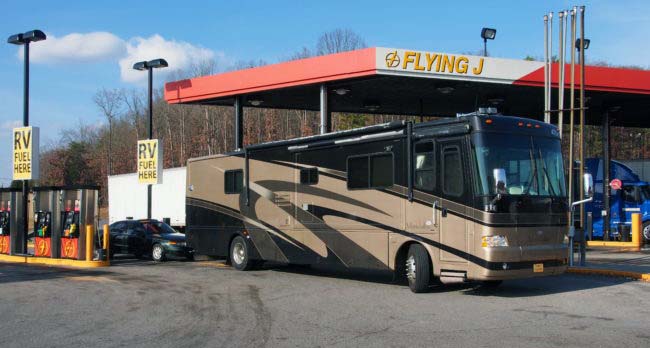
Some Pilot and Flying J locations (and possibly other chains, I don’t know) have “RV” lanes. These are super convenient for some folks, because they are usually off to the side of the regular car canopy, and will often have long pole windshield cleaners, dump and fresh water fill stations, and propane refilling. Lots of people LOVE these RV lanes because they offer lots of amenities for the RVer. I’ve used them, and I’m not a fan, mainly because they don’t have high volume pumps, and they ALWAYS require that you go around the car canopy and right in front of the main building to get in or out, and there’s always a ton of foot and vehicle traffic. Plus, and I can’t stress this enough, the TSD discount does NOT apply at RV lanes. TRUCK. LANES. ONLY.
Stay away from these RV lanes, even if there are signs that say “RV HERE”. You won’t get the better price.
Here’s how TSD makes money from this program. When you use the card, in addition to paying the discounted price for fuel, you pay 10% of the discount to TSD. In most cases, there is also a $0.65 fee that is added that is charged by the truck stop. This means that there are some cases where the card is NOT the best option, and you will need to do some quick math to determine that. If you are going to save less than $0.65 on a fill up and they charge the $0.65 fee, then you are paying more. Maybe just one penny more, but math is math.
So, to keep this super super simple:
Retail Price: $ 3.00 per gallon Discount Price: $ 2.50 per gallon Fee to TSD: $ 0.05 per gallon Transaction Fee $ 0.65
Once you’ve got your shiny new EFS card, you’ll want to get the app. That’s very important, because you will want to use it to see what the prices are like, especially if you are going to be fueling near a city. TSD gets different discounts not just for each brand, but for each location, so the price can vary a LOT from truck stop to truck stop, especially around a city. On the open road it will be less so, but you still want to know what your options are. The app is not required. You will still get whatever discount is available if you use the card at a participating location, but you’re flying blind without the app and in some cases you will pay more than you need to, so I highly recommend the app.
Please be aware that while I was writing this I got an email from TSD telling about a MAJOR update coming soon to the app, so I will update this post once that happens with the new info and changes.
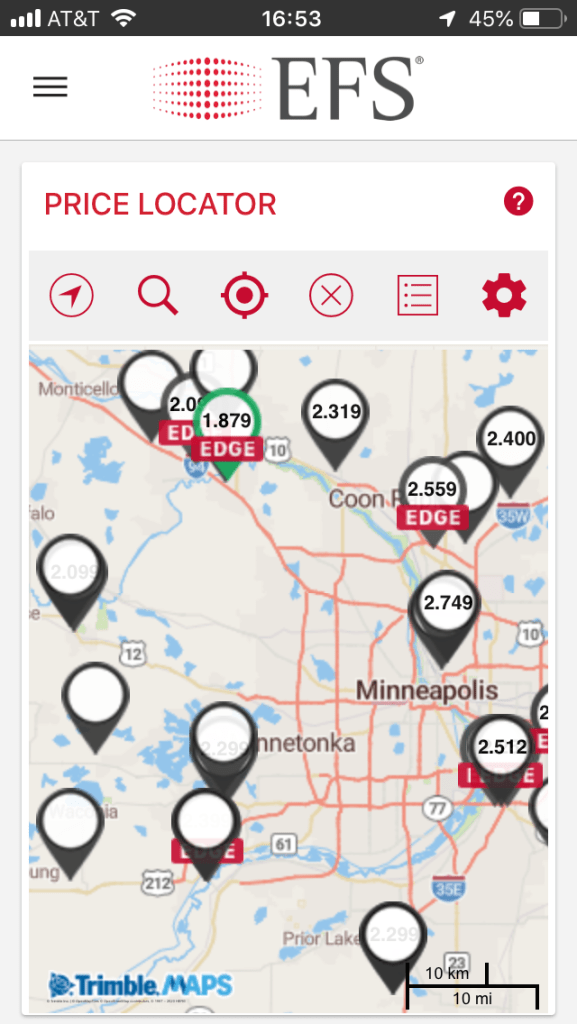
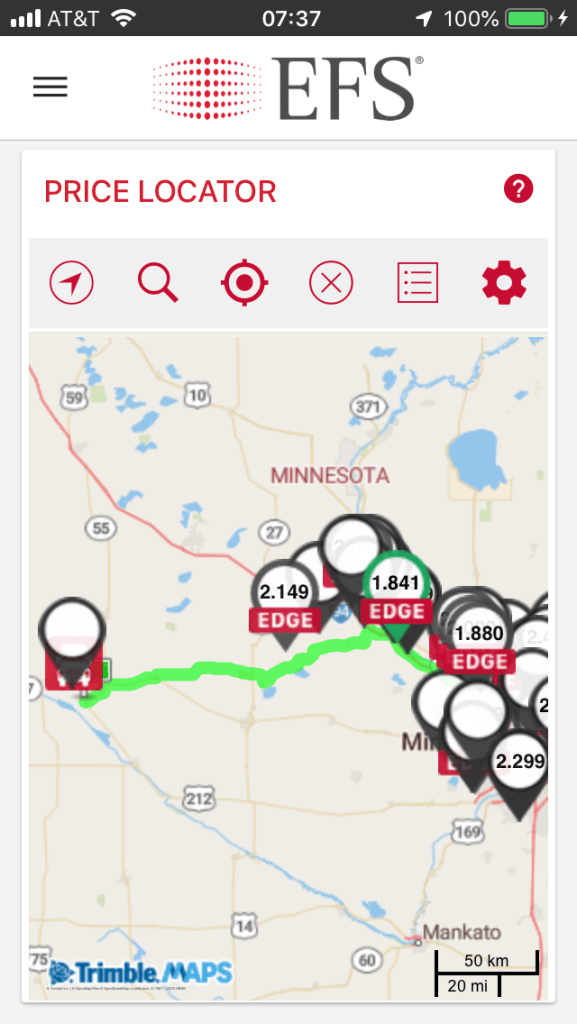
Right out of the gate I have to say that I am pretty unhappy with the app just as a spoiled user of technology. In this day and age it feels un-intuitive, and clunky. It works, but you will find it wanting. Download it, and to start with you will need to enter the entire ridiculously long card number. Your thumbs will get tired. Then the password. If you have the option, tell your phone you want to do the thumb scan or whatever other shortcut for logging in in the future. Sometimes when you launch the app after you’ve told it to remember all the info, the info isn’t there, and you have to close and reopen the app. And then it’s there. The first screen is just a list of your recent transactions. To see what’s available near you, you can look at the map, which will show you locations and prices within a radius that you can preset in preferences. For the purposes of this example, I am showing nearby Minneapolis:
The lowest price will always show up as a green icon, which I think is a nice feature. Other locations show the price. Locations where there is no price usually means that there is no negotiated discount. They will still take the card, but you will pay the “street” or cash price. If that’s the case, you should NOT use the card, because in addition to the street price you will pay the $0.65 transaction fee. But in this example, you can see that $1.879 is the current lowest price.
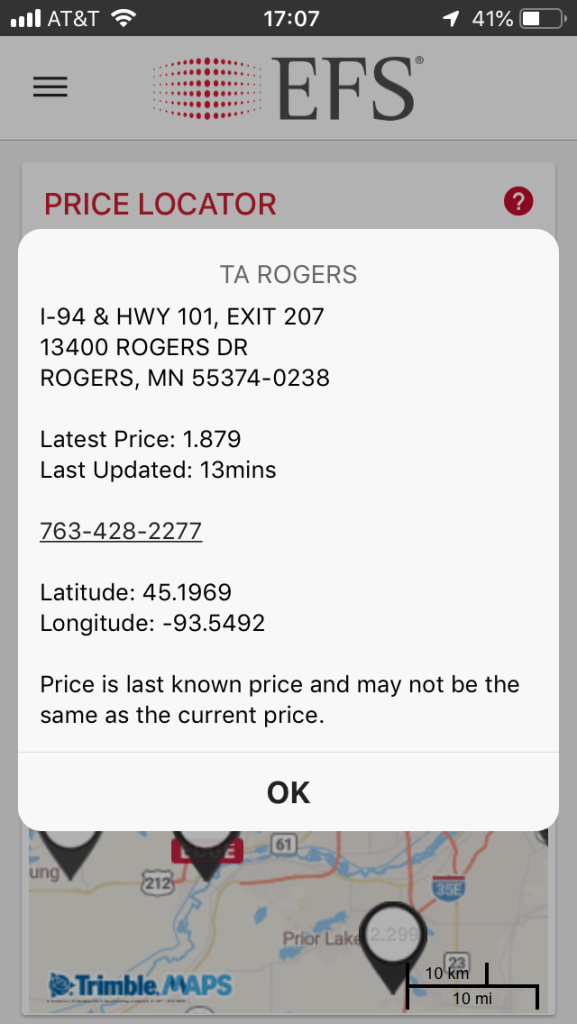
TSD negotiates a discount on the per gallon price, so if the station changes a price, the TSD price changes accordingly. If I tap on that location, I see that it’s a TA (TA is usually the best price based on current negotiations between the chains and TSD.) You can also see the address and lat/lon of the truck stop, but that’s it. (I really don’t like this. I often pick truck stops based not only on gas prices but food options. When its hot we tend to grab some fast food at these stops. If you always use your RV bathroom and RV kitchen to eat this is less of an issue. -Trace)
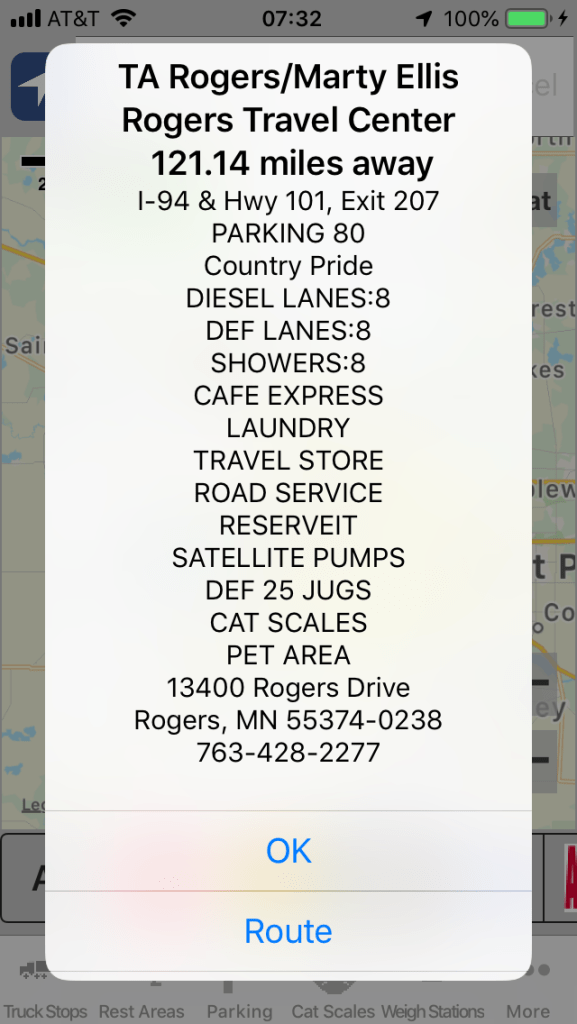
I don’t know why, but they choose not to include other useful stuff. Here’s a screen shot of the same truck stop in the Truck Stops Pro app. As you can see, it tells me the same info, but also tells me the distance, how many parking spaces there are, how many lanes, how many DEF lanes, LOTS of useful info. And I can click “ROUTE” and it will dump the address into my maps app to take me there. ALL of this should be in the TSD app, in my opinion.
If I then look that same location up in another app, I see that the retail price is $ 2.199. So the discount is $ 0.32 per gallon. TSD Logistics will add a fee of 10% of that, which would be $ 0.032 per gallon, so the “adjusted” price per gallon is now $ 1.919. That means to fill my 35 gallon tank will cost $ 67.16 plus the $ 0.65 transaction fee, for a total of $ 67.81 instead of $ 76.96. I saved $ 9.15 on that fill-up. I know that seems like a small amount after all the buildup, but that’s about 11% savings. Based on that if we had used that card all last year, we would have saved $600. If someone were to say, here’s $600, do you know what you would do with it? (Trace would buy presents for our grandson.) (You bet I will – Trace)
Here’s $600. You’re welcome.
The app also allows you to do basic Point A to Point B route planning that shows truck stops along the way so you can plan to take advantage of the lowest prices.
But here’s another major failing in the app, for me. In order to do routing, you must have a city, state and zip code. That’s just stupid. So now while you’re bouncing down the road your copilot has to look up zip codes on the internet just to put in a “TO” location to get a green line to show you truck stops along the way. This NEEDS to be fixed. (Totally agree. I was using two different apps just to make this work. I would find the location on the EFS app and then look up the other info and routing. It was pretty frustrating initially, but I ultimately got the hang of it. I found it was MUCH easier if I did it way in advance so I wasn’t trying to find a place under pressure. – Trace)
As I mentioned, they are releasing a new version of the app in a few weeks, so hopefully some of this no-brainer stuff will be fixed. I will definitely be updating this post with the new information once the app is released. In the meantime, here’s the text of an email I received talking about various upgrades:
“We are releasing a beta test on our new TSD app this week. We are estimating a public release by the end of August to all iOS users, with the Android release shortly after that. It has some really great, new features including the ability to track multiple cards at one time, more details on each fueling station, the ability to send feedback to TSD on an individual station, and many more opportunities for savings. One of those opportunities will include access to new insurance options for you and your RV. Soon, you will be able to request a no-obligation quote directly from the new app and take advantage of the collective buying power of our entire group. We are also making big investments in our billing system to allow you more visibility and accessibility to your account. This will allow you to sign up for an online account where you can view all of your ACH statements, edit your bank account information, see your referral credits and monitor your account status in real time. Look for an email within the next few weeks to sign up for this exciting, new service. Simply follow the link, agree to the new terms and conditions and create an account. From there, just enter all of your information including your bank account. You will not need to re-enter your social security number or the person who referred you. We are very excited about these new features and we hope this will make your experience with our program more user friendly. We are continuing to improve our program every day and could not do this without the help of you, our loyal customers. You have been instrumental in growing our program and we cannot thank you enough for your continued support.”
So here’s some details of our recent drive from San Antonio to western Minnesota, and what we saved:
Starting out from San Antonio, Gas Buddy showed me the cheapest diesel in the area was $2.39, and the retail price at the TA was a whopping $2.75. The TSD price was only $ 2.247. A difference of $ 0.51, which gave them a “commission” of $ 0.05 per gallon, making my price $ 2.29. At 32.5 gallons I paid $ 74.42 instead of $ 89.37. That’s $ 14.30 savings after the $ 0.65 transaction fee, on a not quite full tank.
And continuing on, here are two screen shots of the “settlement statements” they send to show you what you paid.
For the stop below we paid a 10% fee of $1.54, which means our savings with the 65¢ transaction fee was $14.70.
For the stop below we paid a 10% fee of $1.16, which means our savings with the 65¢ transaction fee was $10.95.
I will continue to talk about how much we save as we travel and data piles up, but clearly this is a fantastic deal. We am doing more or less the same thing we have been doing for six years, but now we are spending less money.
What did I tell you? Starts off small, pretty soon, serious money.
There is a little bad news. As recently as March 2020 you could use the TSD card at Pilot and Flying J locations, but that is no longer the case. Customers are getting the shaft because a couple of big businesses don’t know where their money comes from. Good Sam has an exclusive discount program with Pilot/Flying J. RVers are only to receive discounts on fuel at Pilot/Flying J IF they have a Good Sam membership card. Let me say that again, Pilot/Flying J has an agreement with Good Same that ONLY Good Same card users get a discount. I do NOT agree with this practice, for one very simple reason. The marketing for the Pilot/Flying J Good Sam card touts all the savings you can get EXCLUSIVELY with the card. We have that card, and while it does give us 8¢ off the cash price at Pilot/Flying J, that price is consistently AT LEAST 10¢ higher than all other truck stops, even the ones directly next door or across the street from Pilot/Flying J. So, no, I don’t think it’s smart of them at all to lock in customers and essentially give them nothing. TSD was not aware of this until they got a call from the management at Pilot/Flying J, who put out the following statement:
“Pilot/Flying J is no longer in business with TSD Logistics (TSD). Unfortunately, it was recently brought to our attention that TSD was reselling our fuel by offering its discounts outside of the company.
We were unaware of this activity and did not agree to the resale of our fuel. Our contract was with TSD and its fleet of drivers only.
We aim to provide the best experience to all of our guests, including RV and auto travelers as well as professional drivers. We continue to offer discounts and rewards to RV customers through our partnership with Good Sam. This partnership had no influence on our decision to end our business relationship with TSD.”
From my perspective, there is now no reason whatsoever to do business with Pilot/Flying J, as they are always going to be the most expensive option. And Good Sam is unwilling to budge on their exclusive arrangement, so I am now no longer interested in doing business with them, either. Now we’re huge fans of TA, currently the leader in discounts on the TSD card. Everyone is winning but Good Sam and Pilot/Flying J.
I hope this post has been informative and helpful, and as always I am happy to answer any questions anyone has. I will also update the post as new information becomes available, and once I try out the new app. Don’t forget, if you decide to sign up we will get a little fuel credit down the road after you’ve bought 100 gallons of fuel, so consider putting Lee Perkins in the “referred by” field and then go right on out and drive around in circles for hours and hours. Here’s one more picture for you for sticking through all the way to the very end.
Supporting our Blog
We very much appreciate your support of our blog.
You can purchase the ebook telling the story of how we became full-time RVers.
You can purchase our recipe book filled with 80 recipes we have cooked in our RV and taste tested by Lee himself. You can purchase the kindle or paperbackversion on Amazonor buy the Apple version on iTunes.
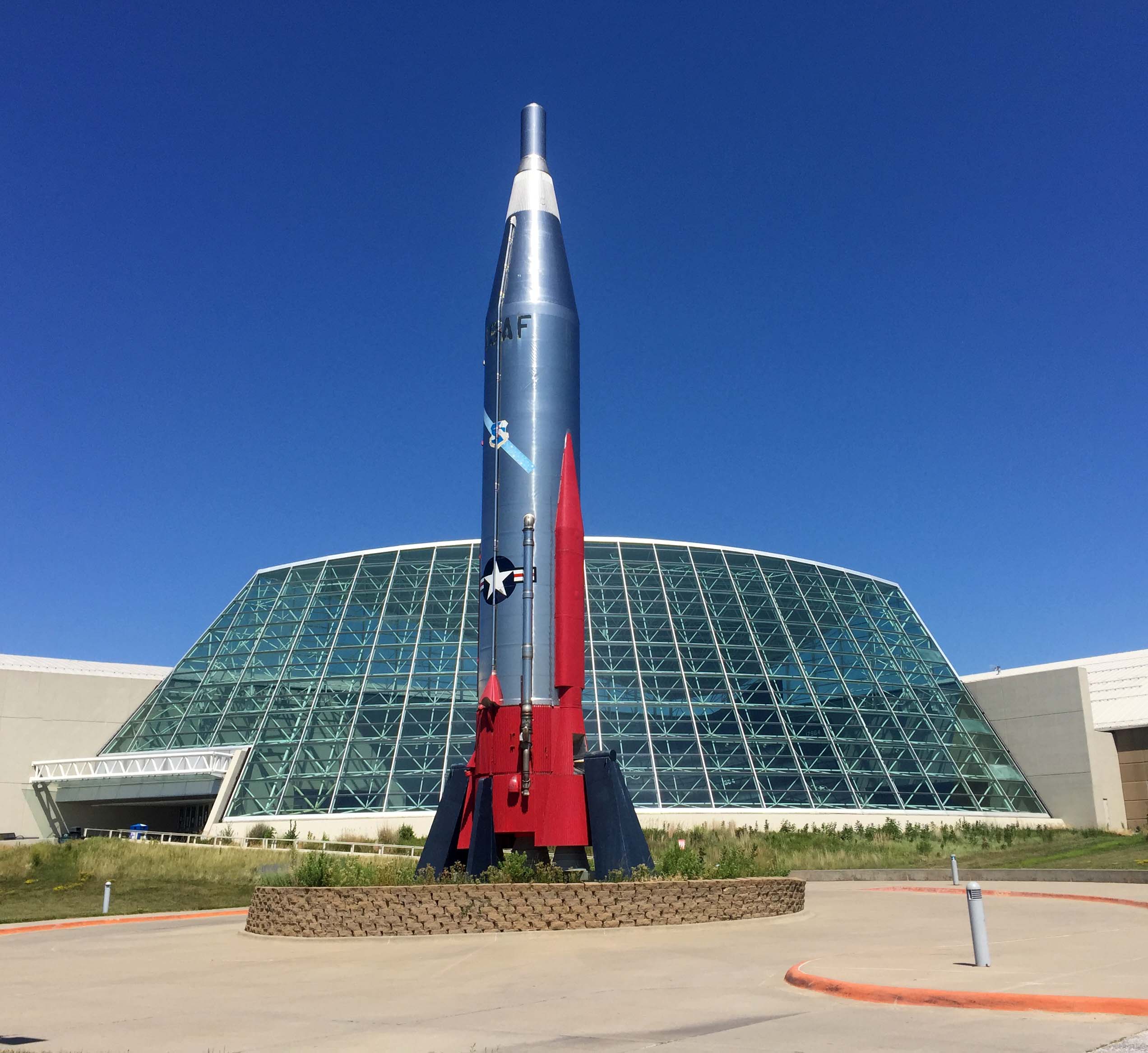
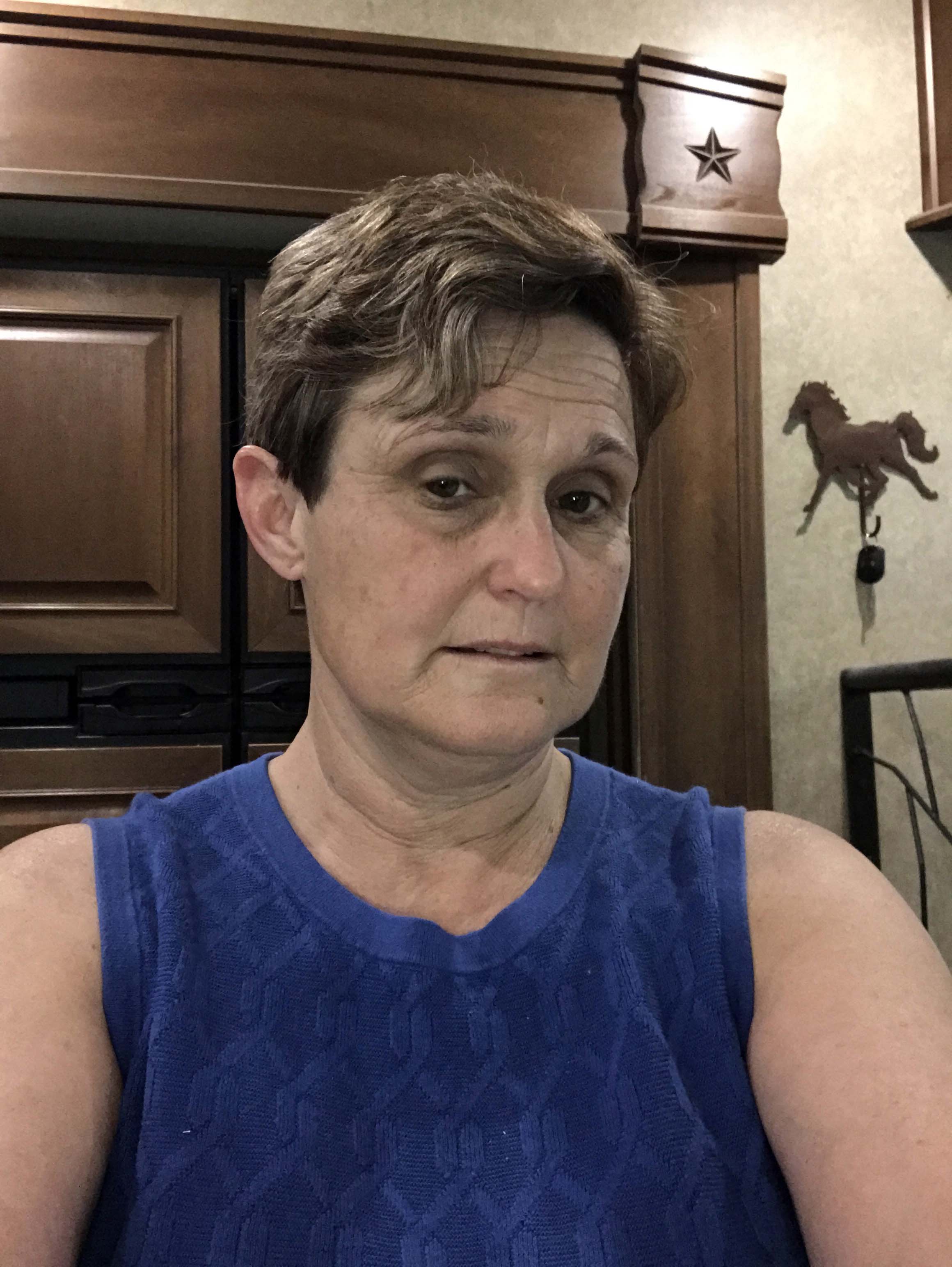
Although many of the museums were closed in Omaha, Lee was able to visit the Strategic Air Command Museum. It was inside a huge building with hangers and since it was a Friday morning hardly anyone was there. He’s going to do a separate post on that. (No, really, I will. I promise. – Lee) Since I had the day off I took the opportunity to get a haircut and a pedicure. Lee said he was comfortable with it because there are so few cases in Nebraska, but even I was thrilled with all the precautions they took. Everyone was masked, and at Great Clips the stylist cleaned the chair, work station, and all of her tools before I got my hair cut. It felt absolutely wonderful to do something so normal again, and I enjoyed every minute of it.
Strategic Air Command Museum
Yeah short hair!!!
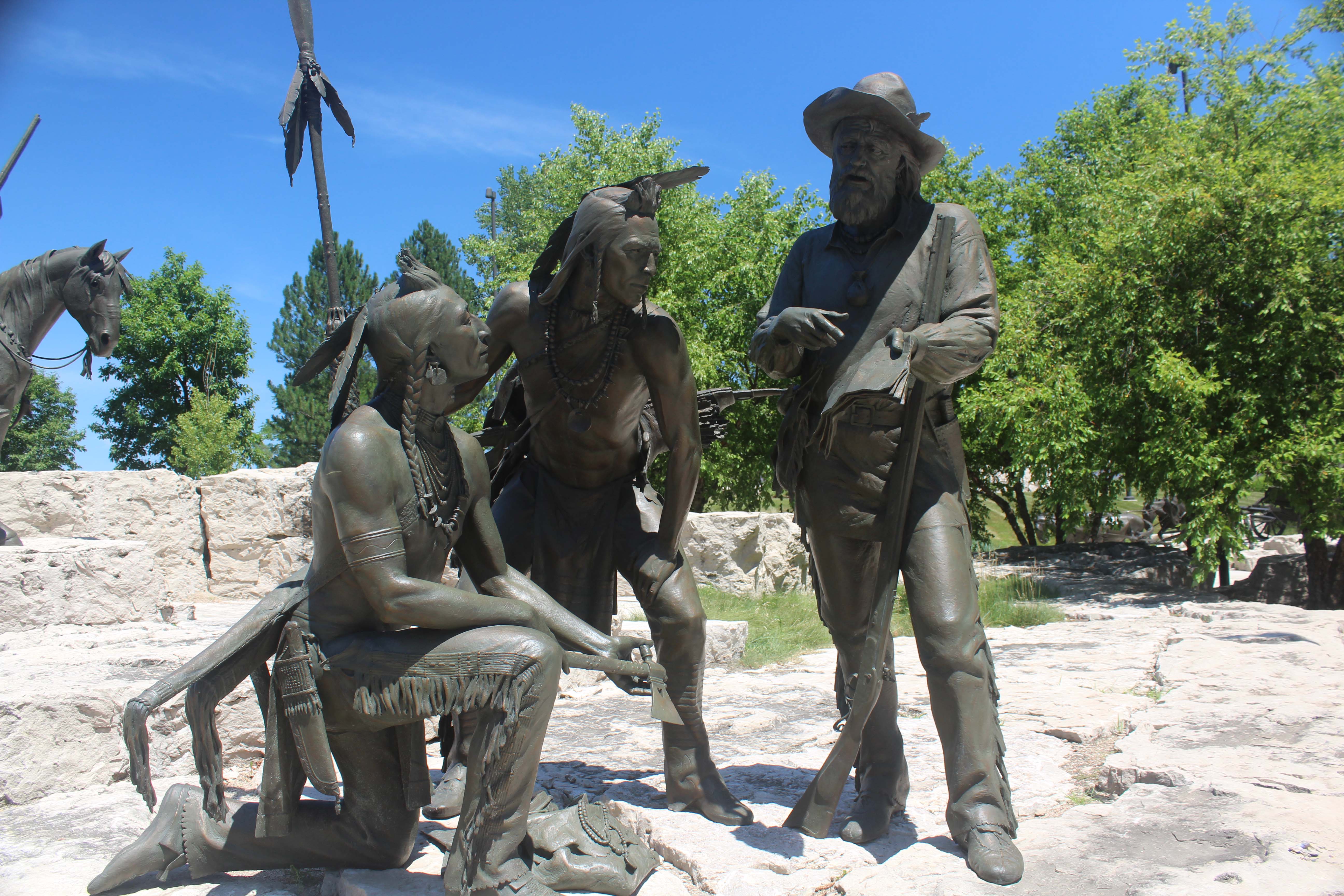
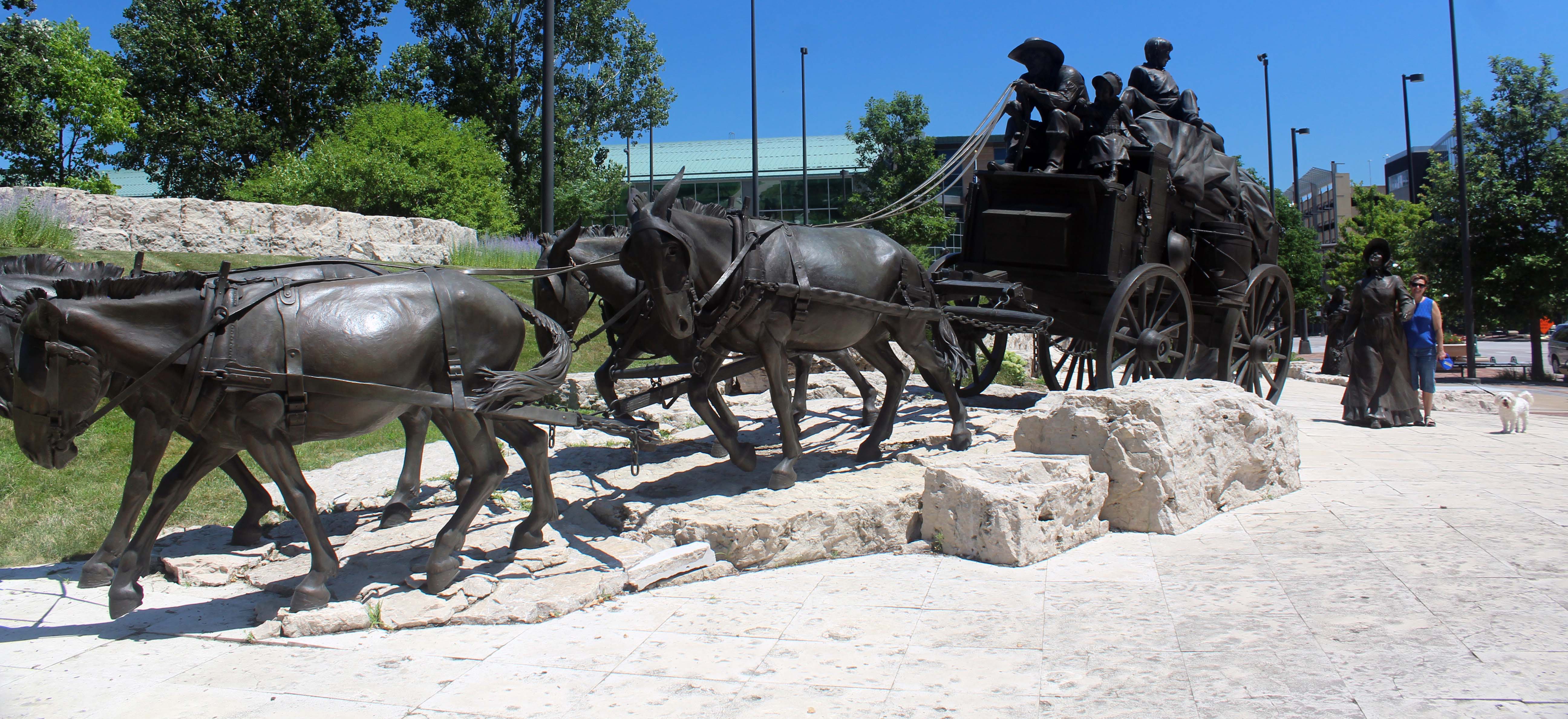
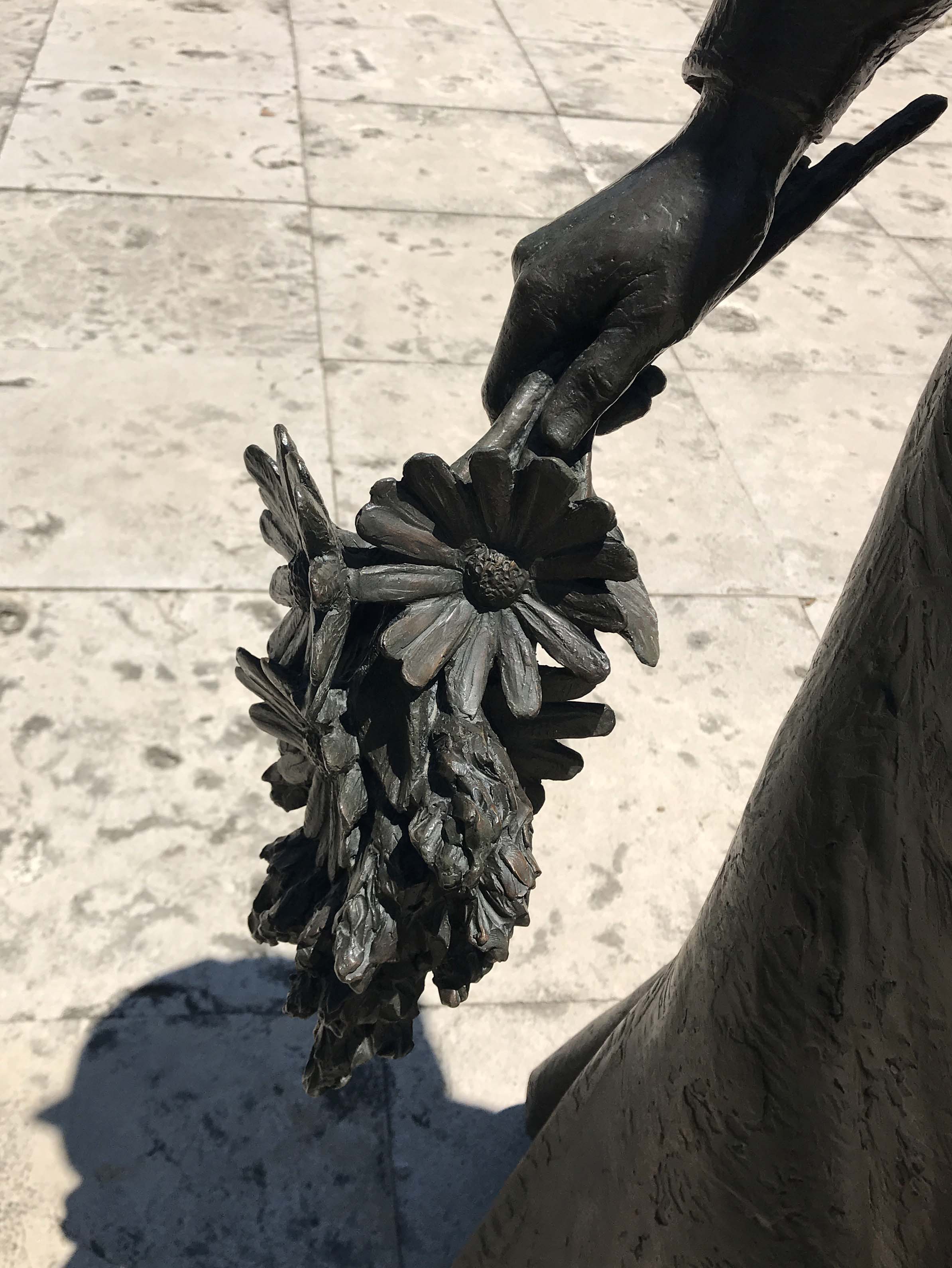
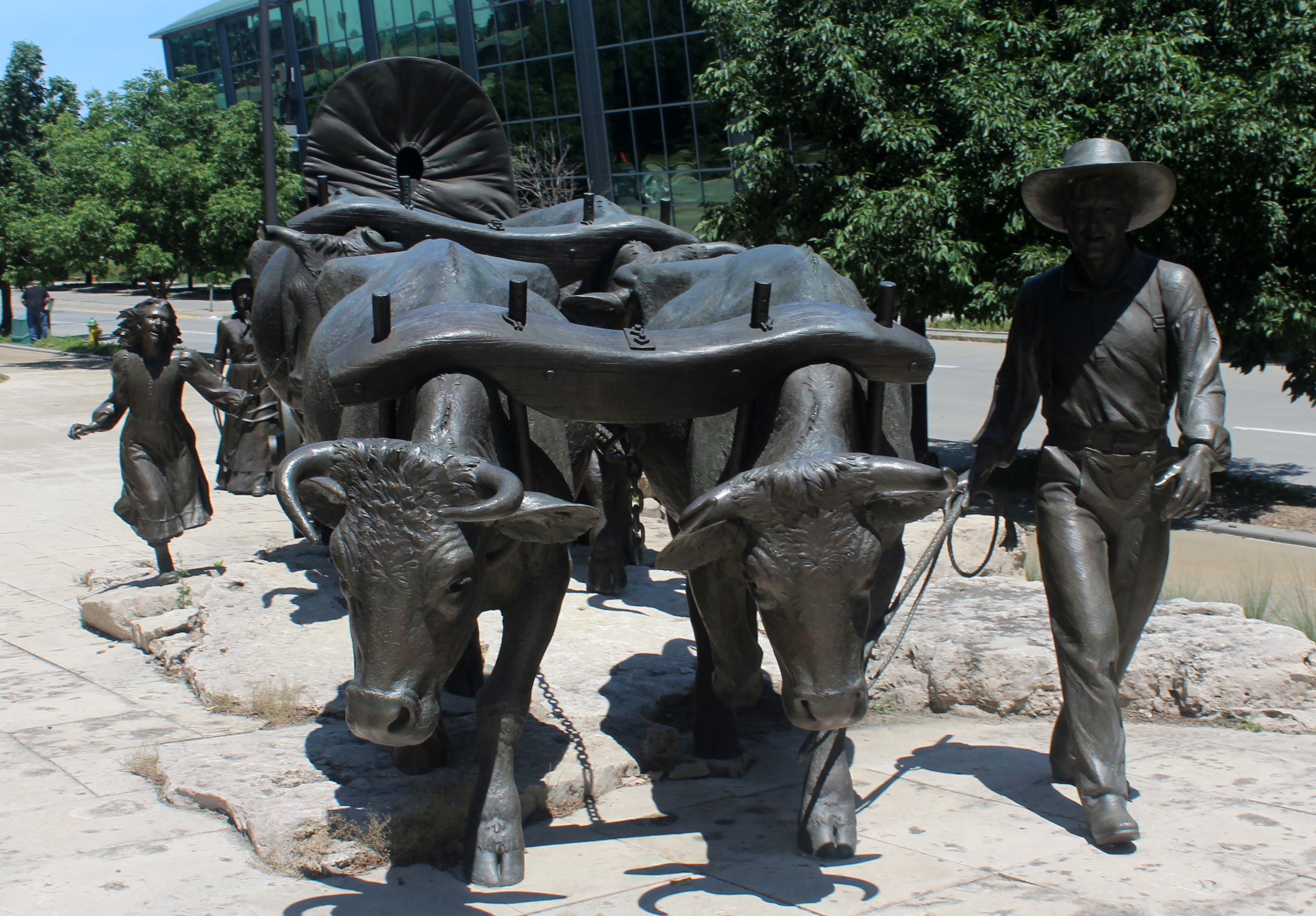
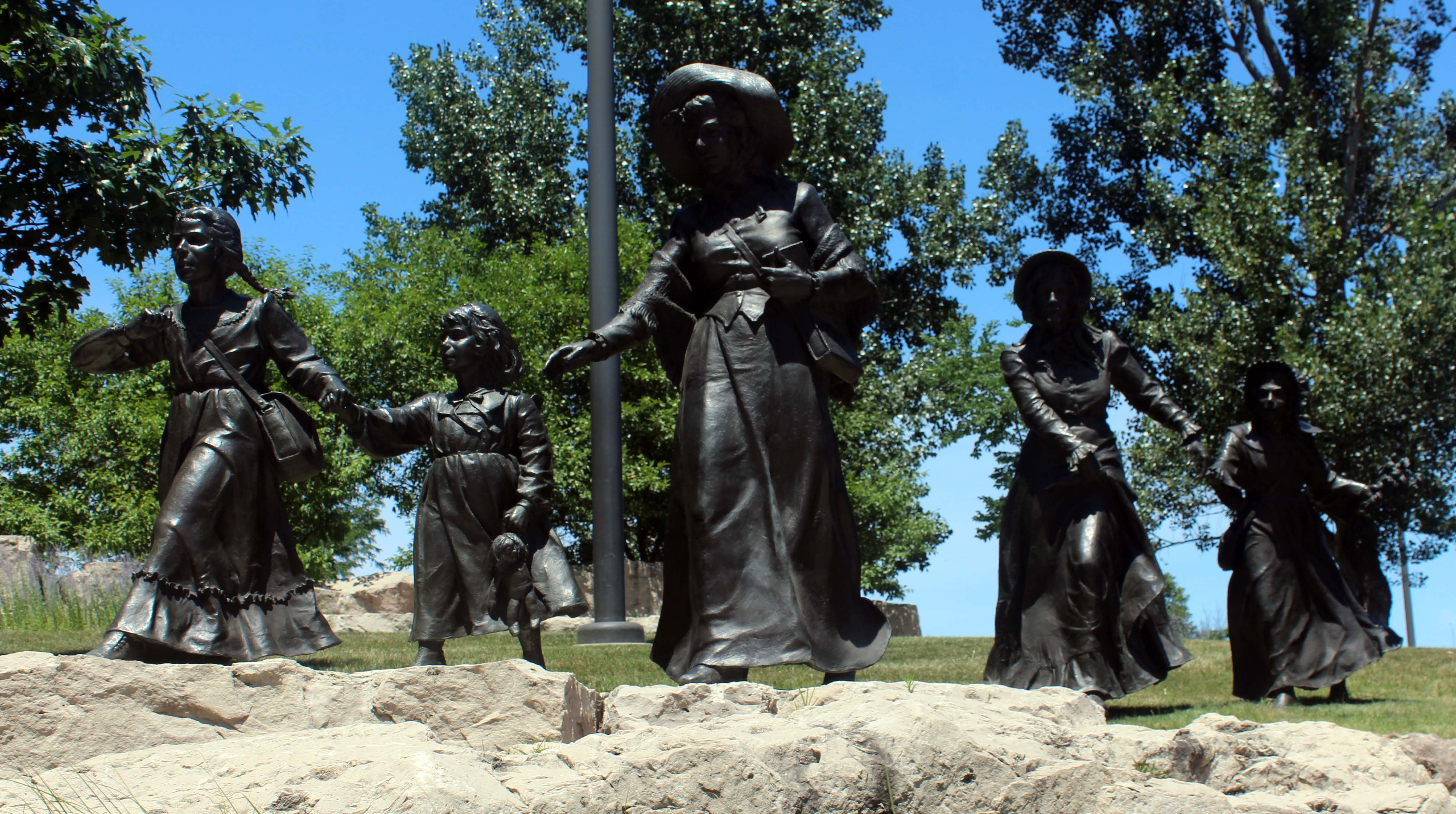
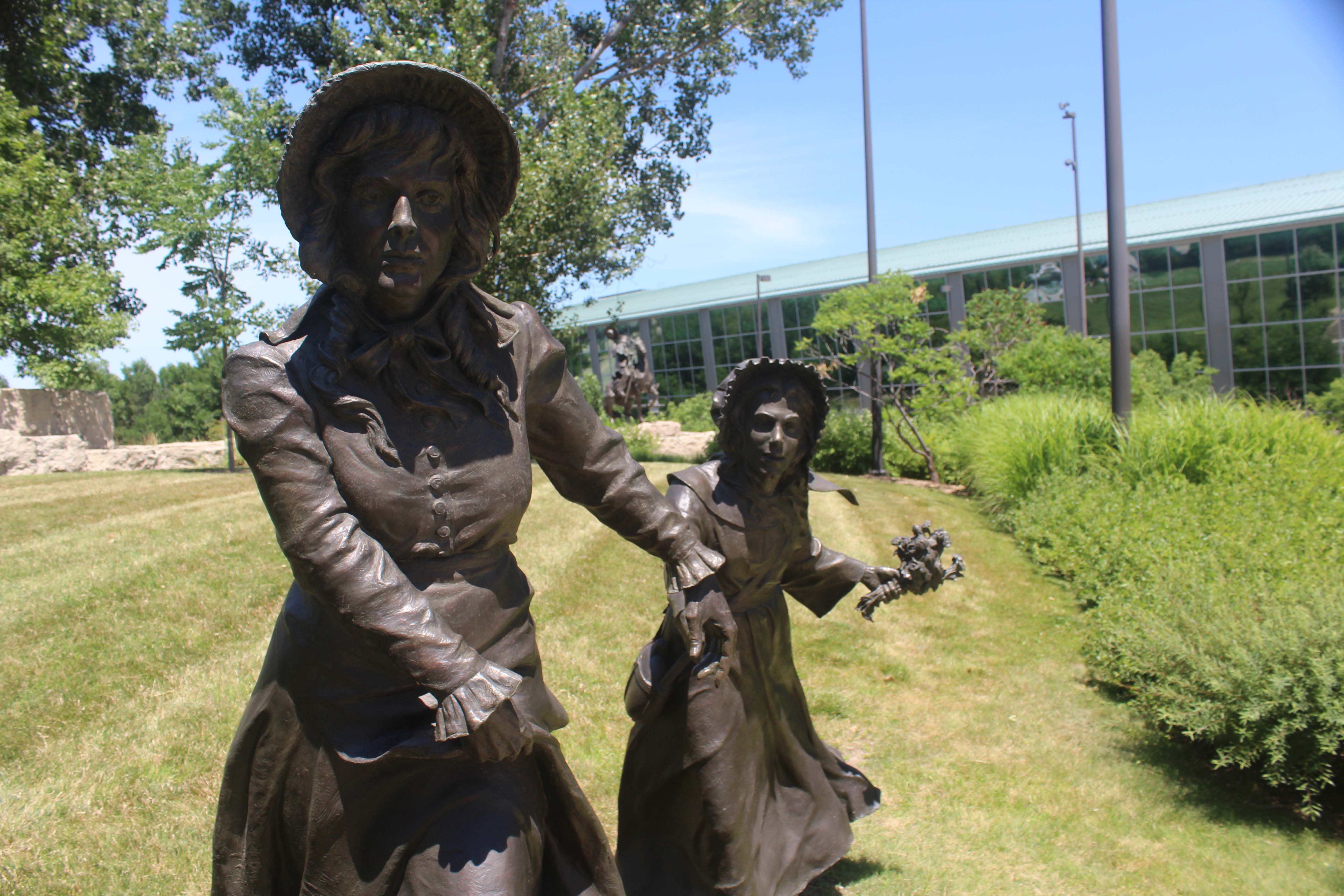
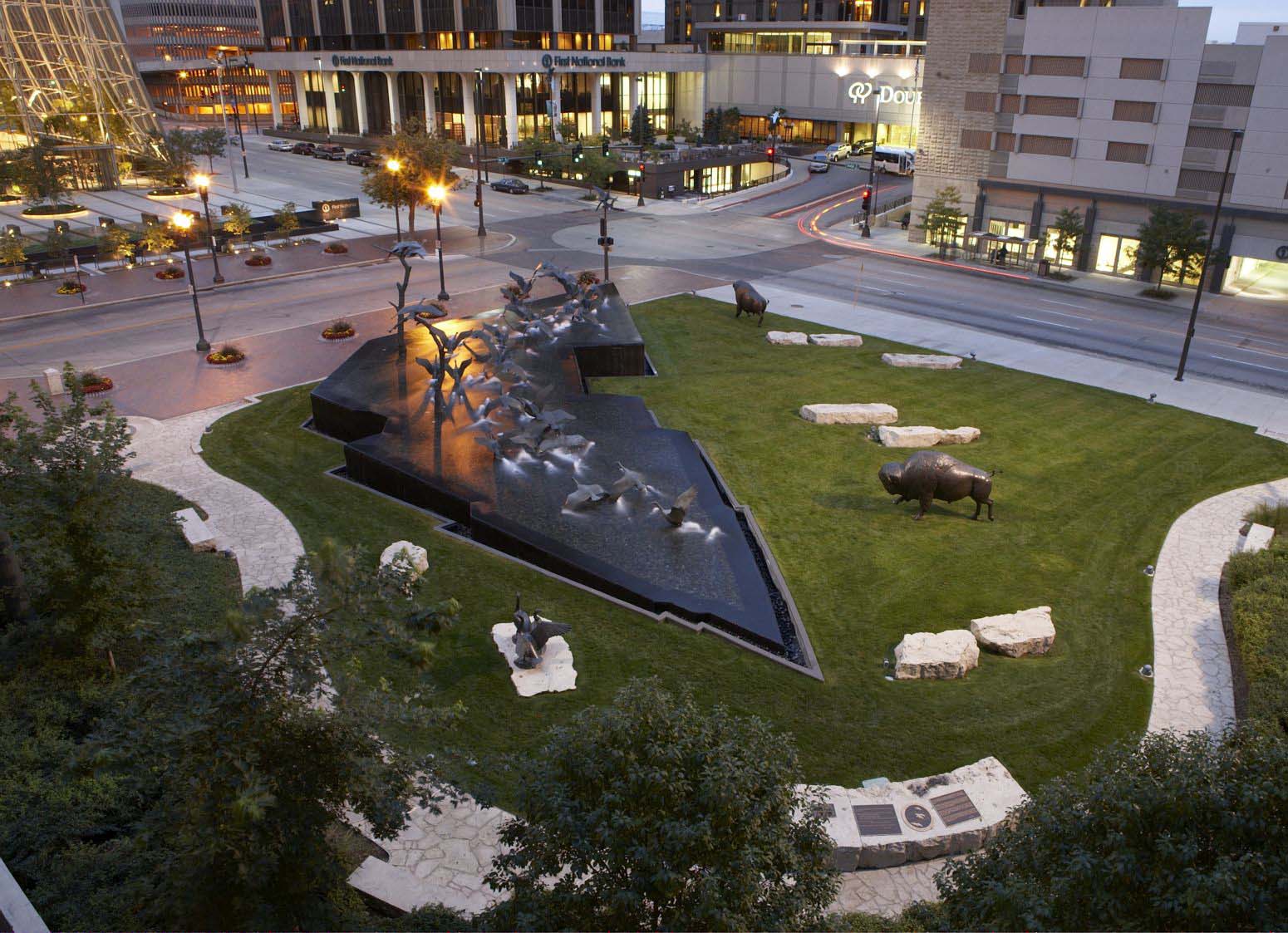
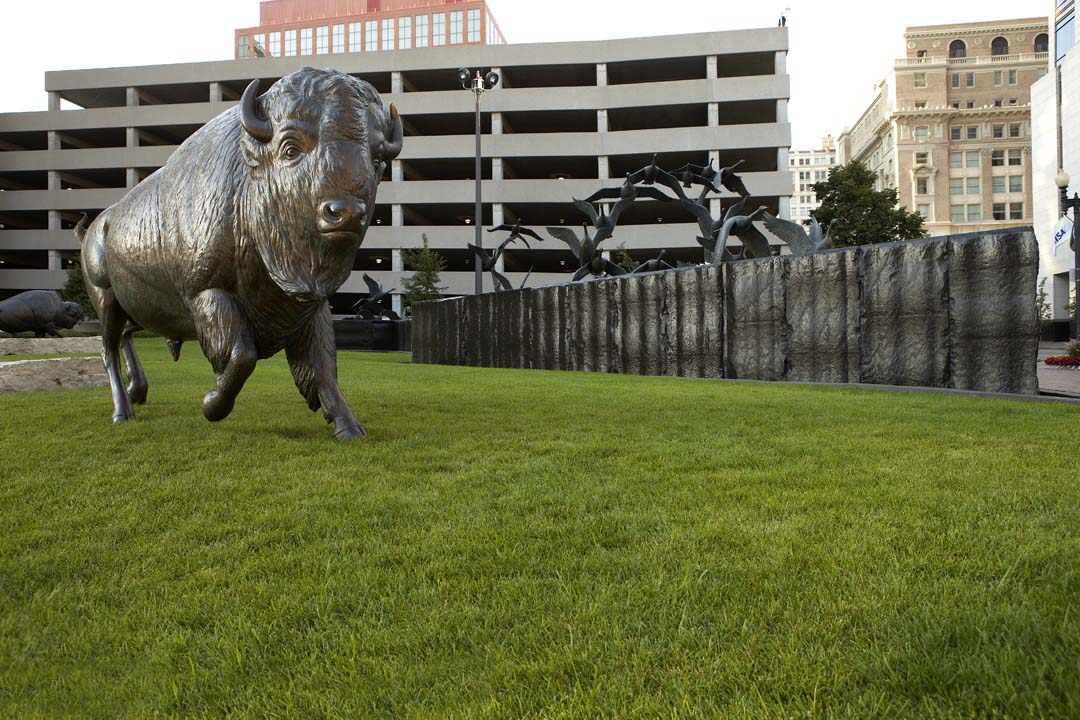
We were planning on going to dinner with his friend Jane later in the evening, but since we had some time after lunch we ran downtown to see an outdoor sculpture called Pioneer Courage Park. The downtown was deserted so we had the sculptures to ourselves. The neat thing about them is they are in several places in the downtown and the overall scene is a wagon train departing for the west from Omaha, with hunters driving a herd of bison, which startles a flock of geese into flight.
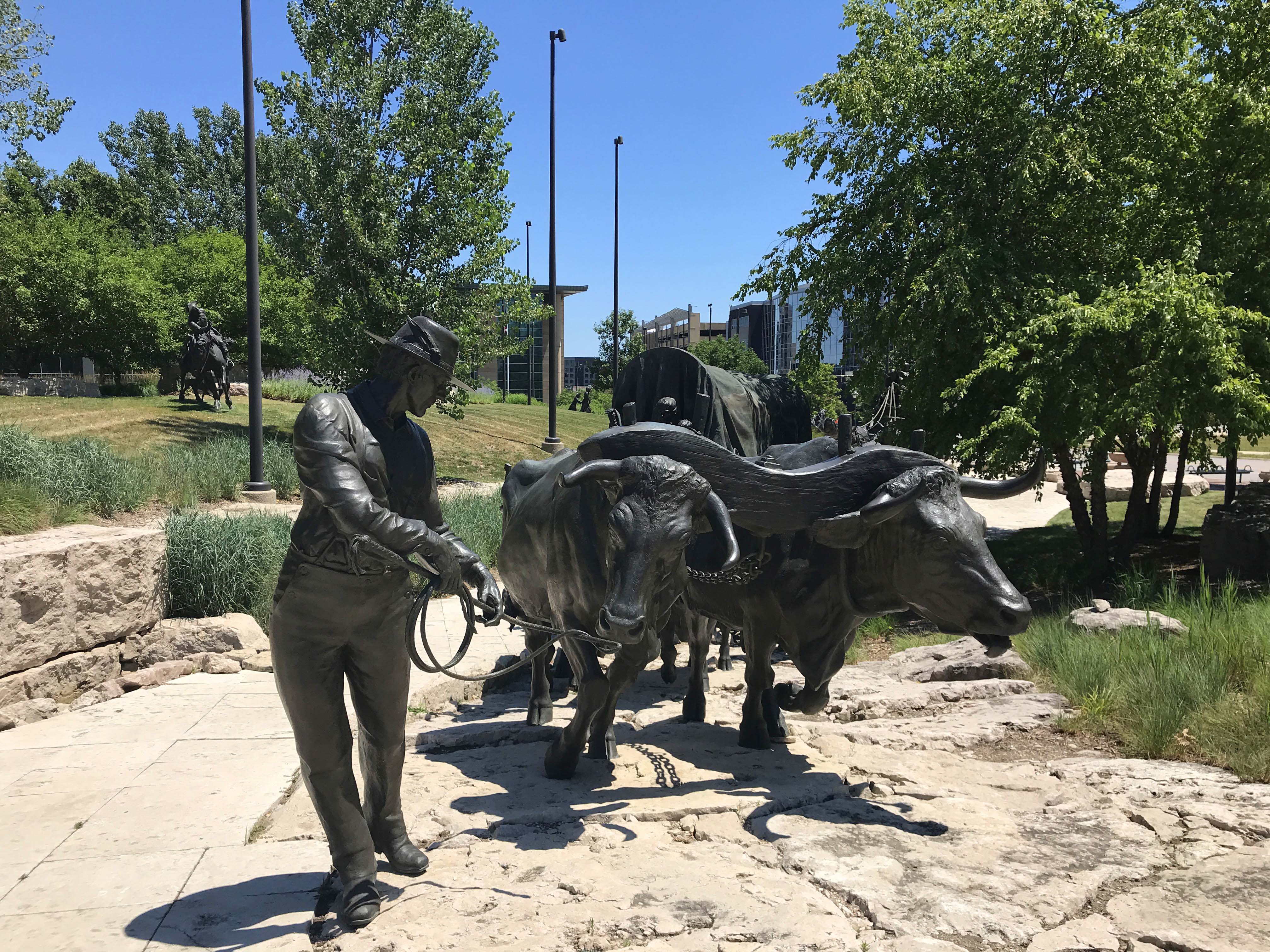
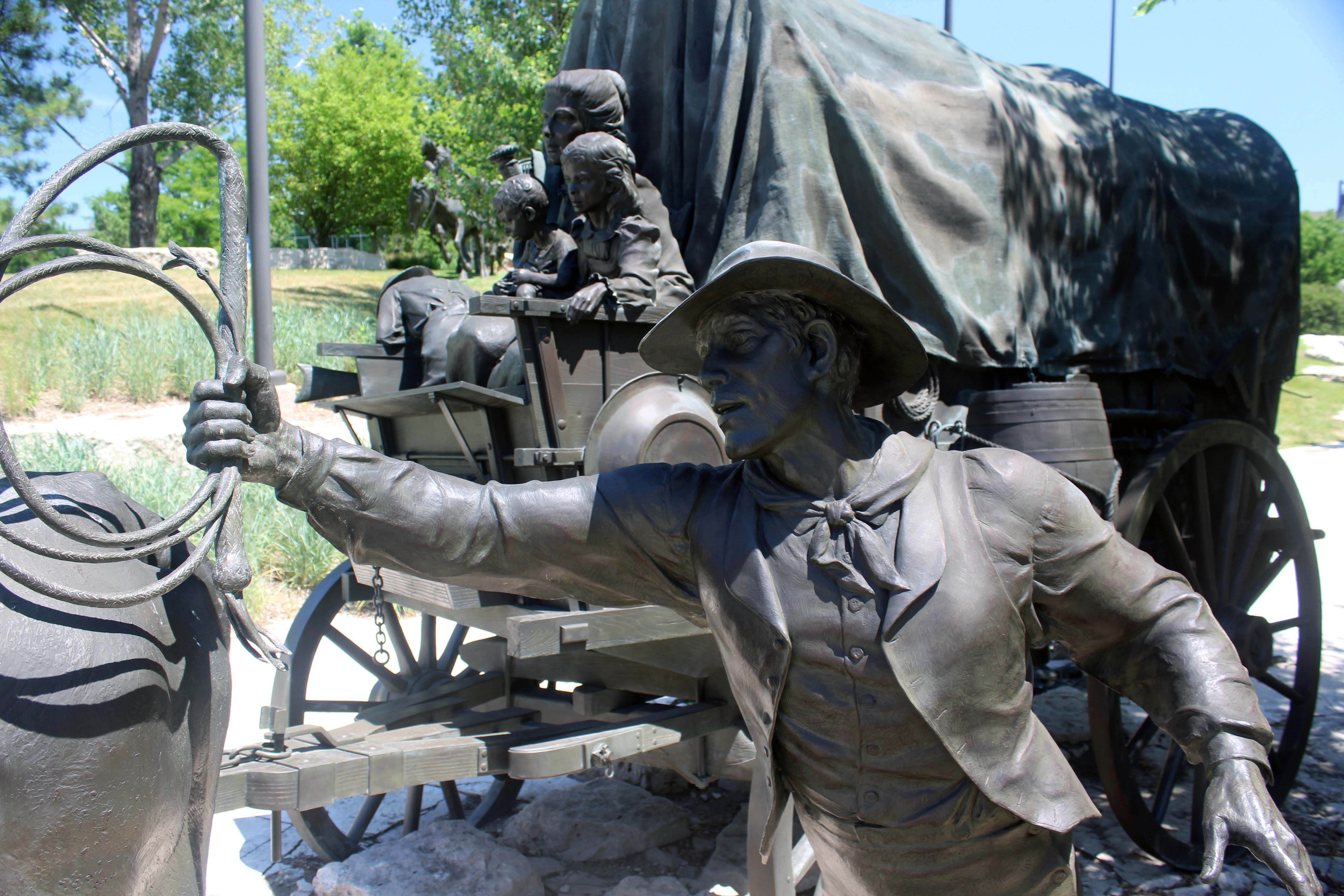
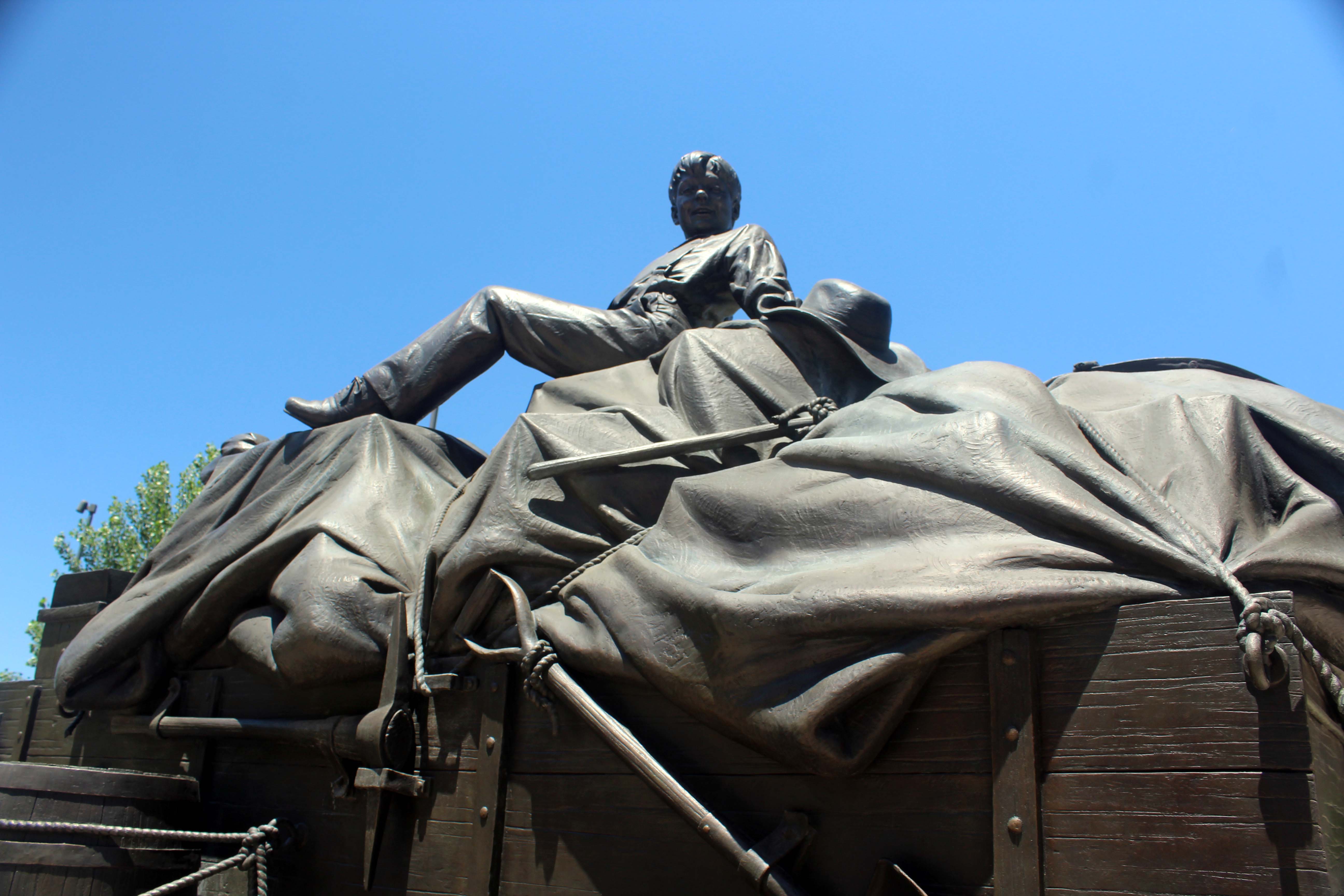
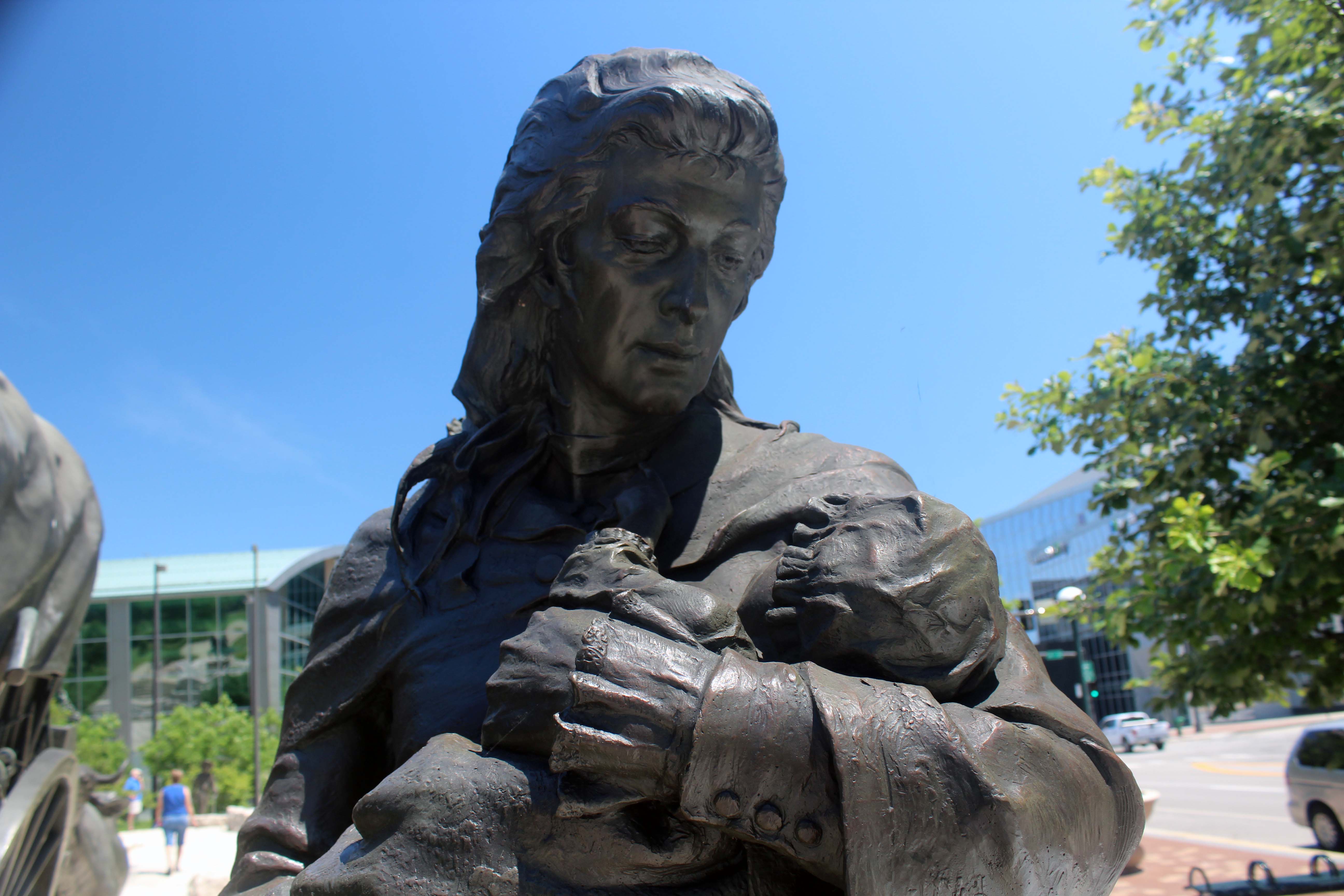
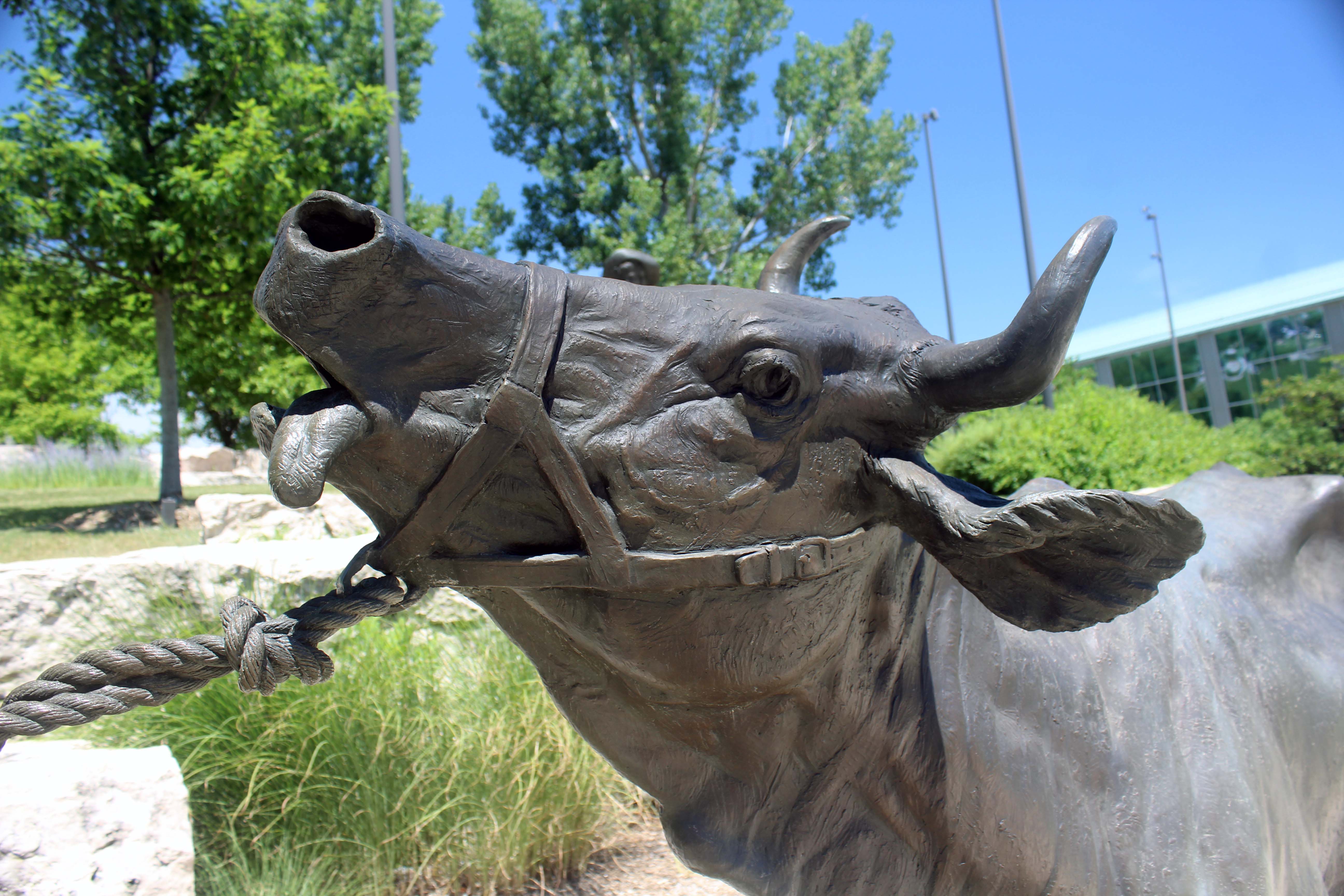
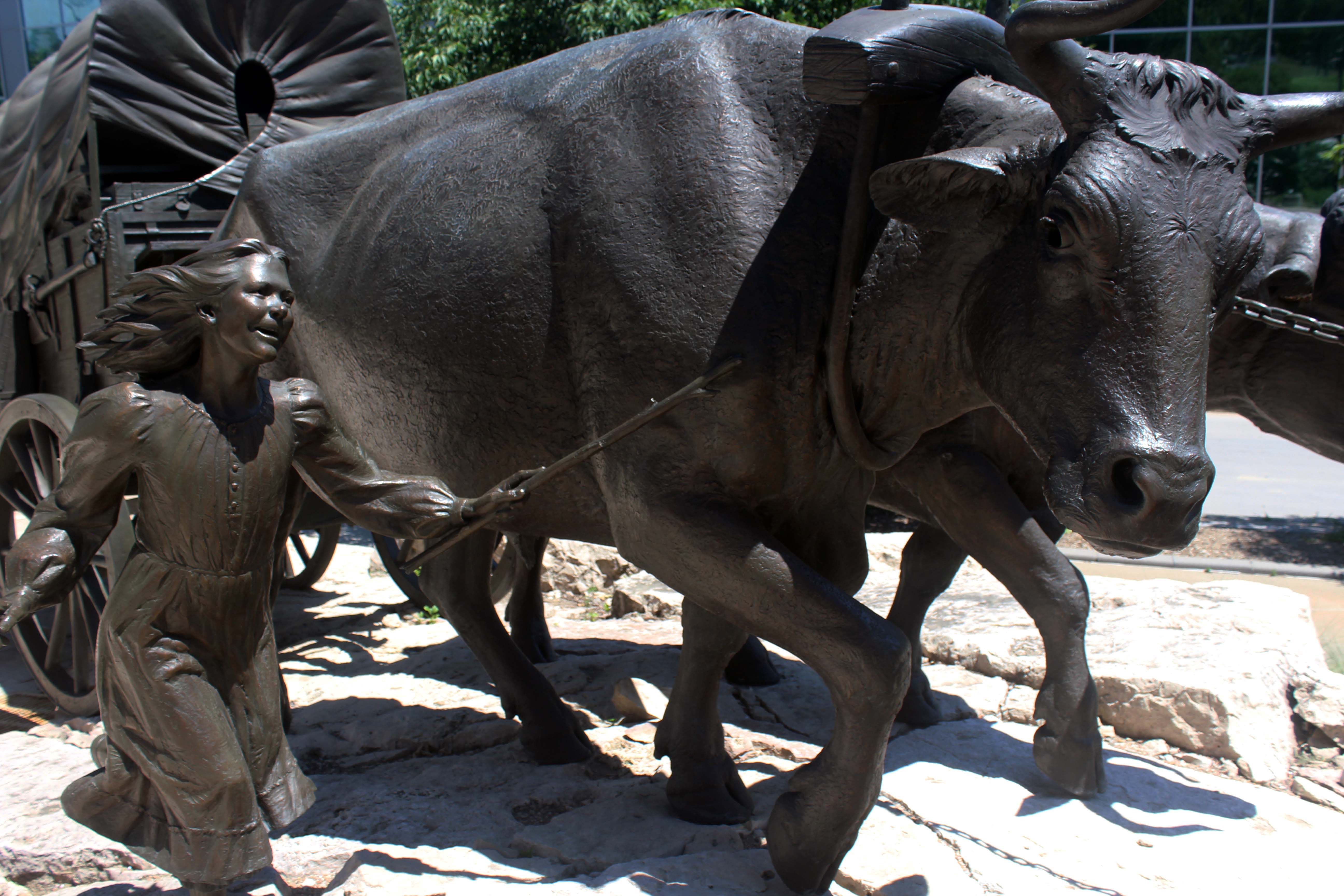
The wagon train consists of four pioneer families and their covered wagons. Each wagon is 12′ high and more than 40′ long including the oxen, horses or mules. Individual people range in height from 3′ to 7 1/2′. As you approach it, it really doesn’t look like much.
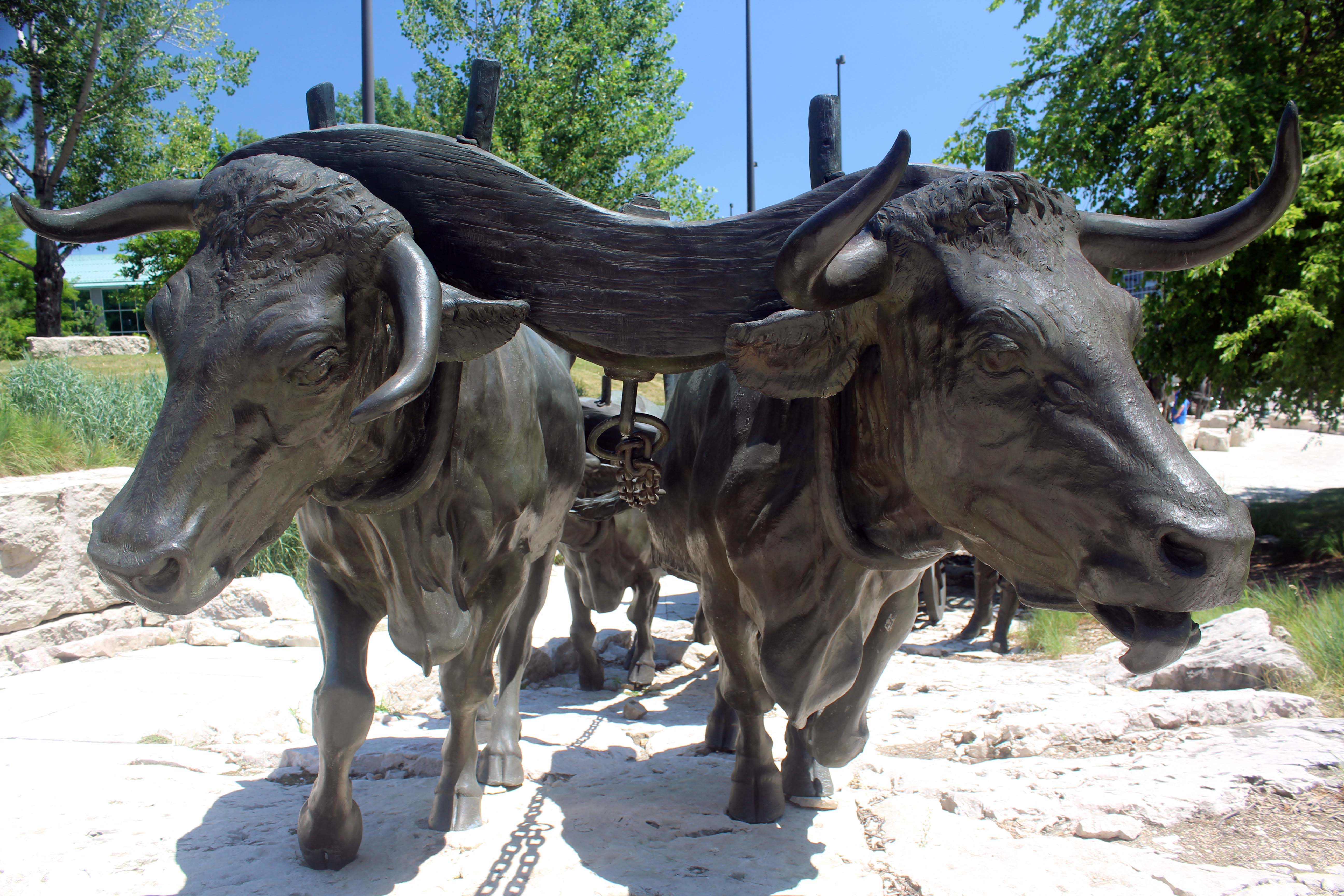
But then when you get close, they are really amazing.
As you can see the wagon train sits right downtown with the skyline in the back
I loved how they artificially created the hoove marks in the ground
And the sculptures themselves were extremely well done. You can feel the oxen straining
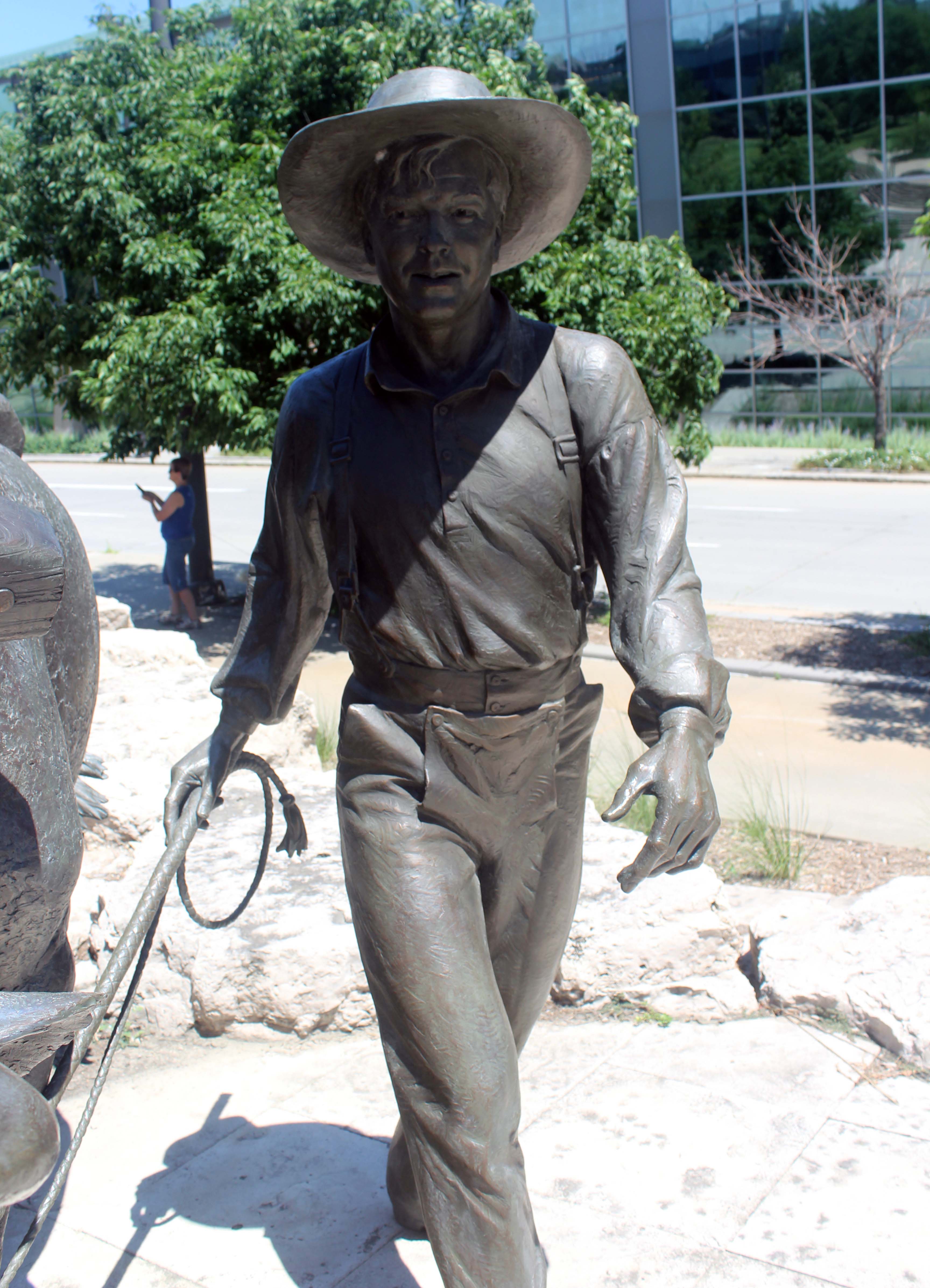
(This guy reminds me of the young version of Ed Harris in West World. – Lee)
The cut a trench in the concrete where the wagon wheel would have been. Love these little details.
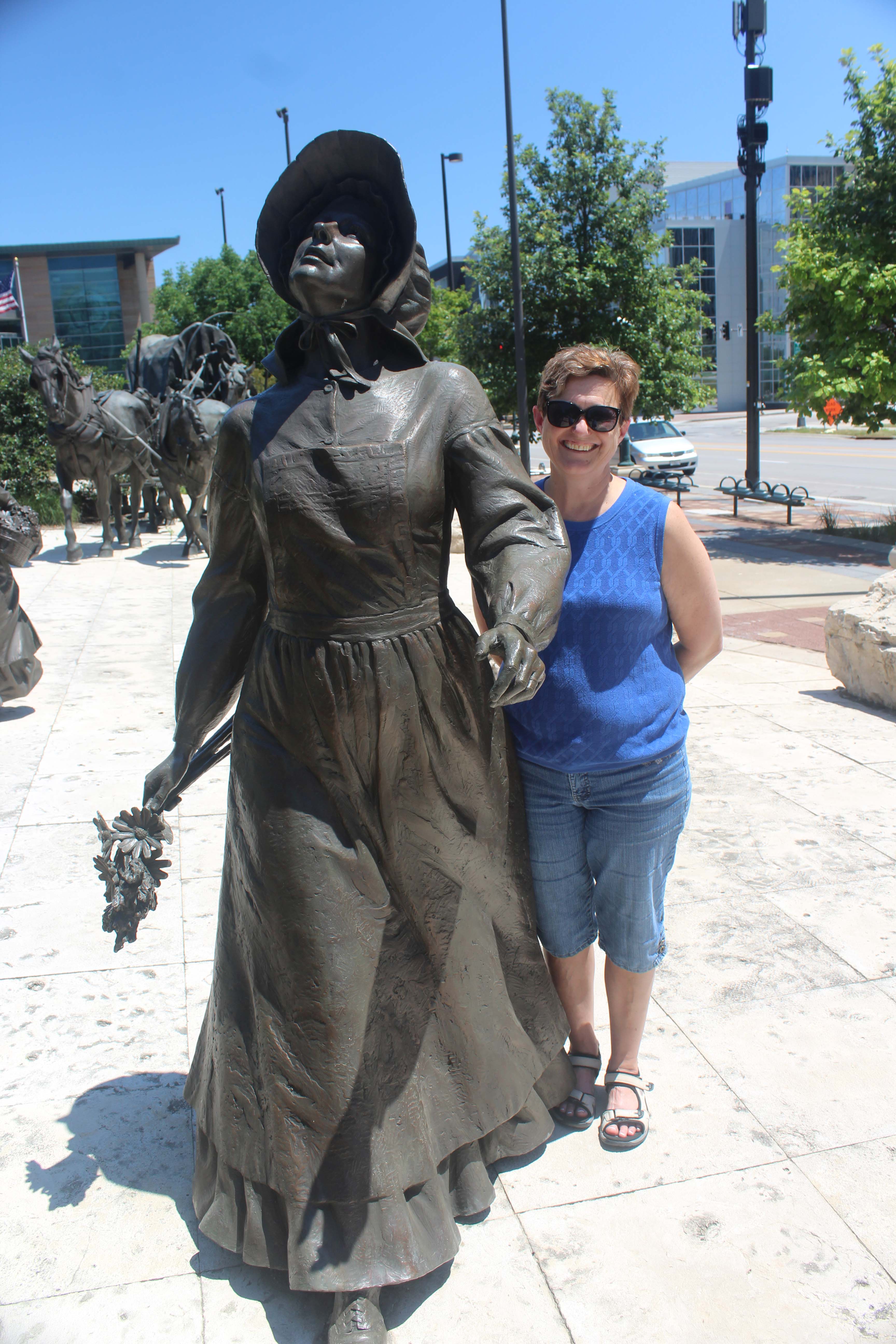
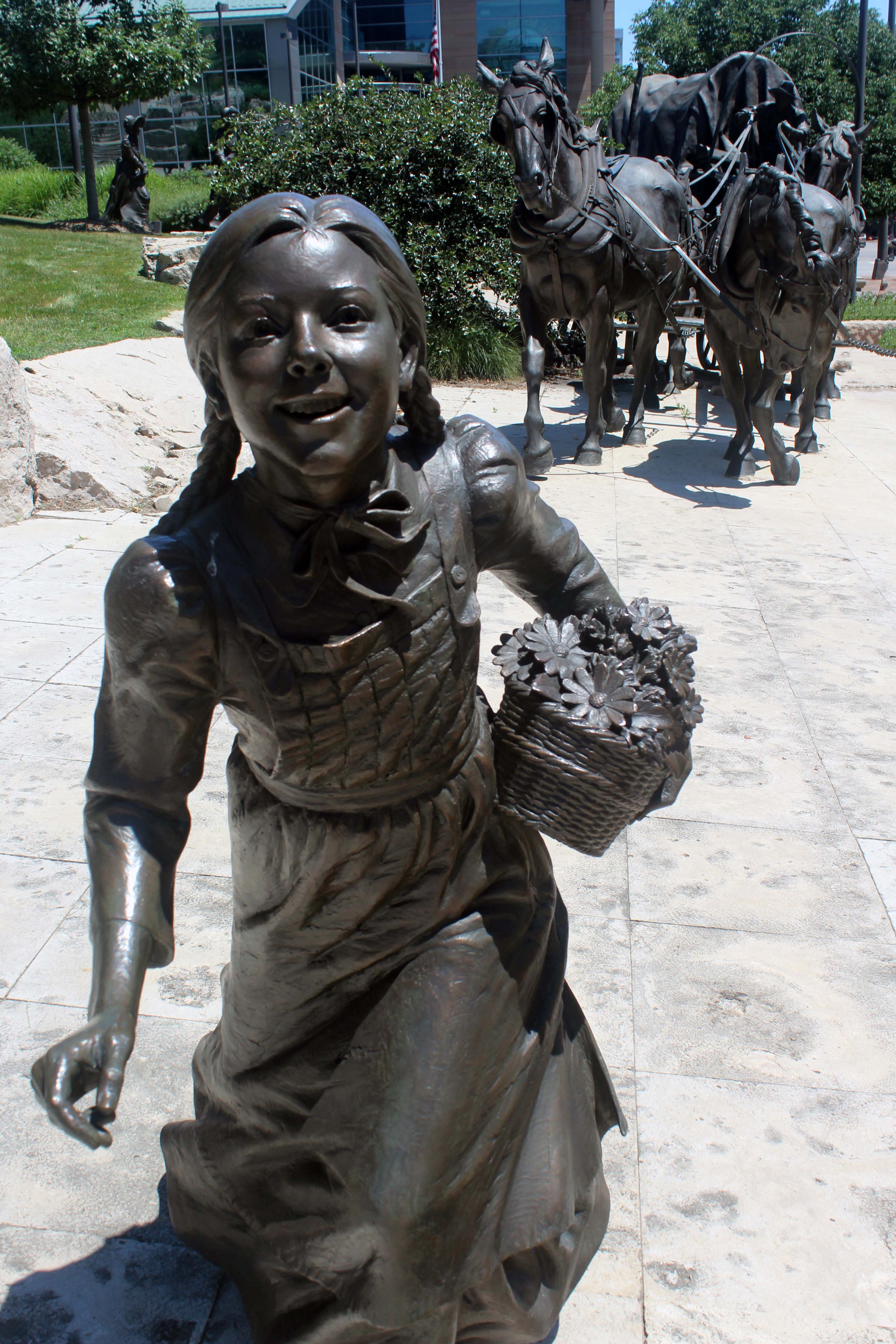
This little girl was probably my favorite
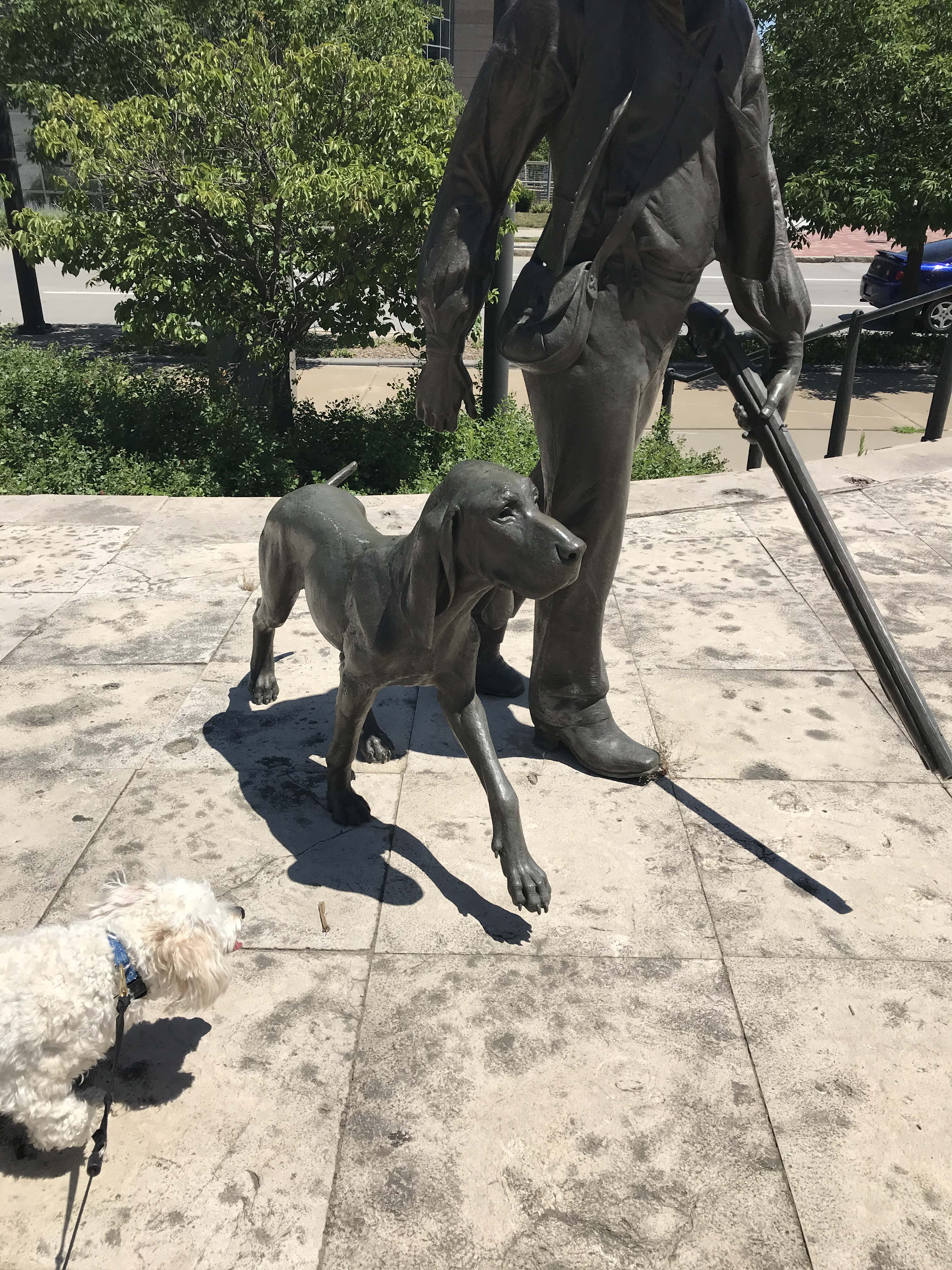
Jack thought the dog was real at first I think
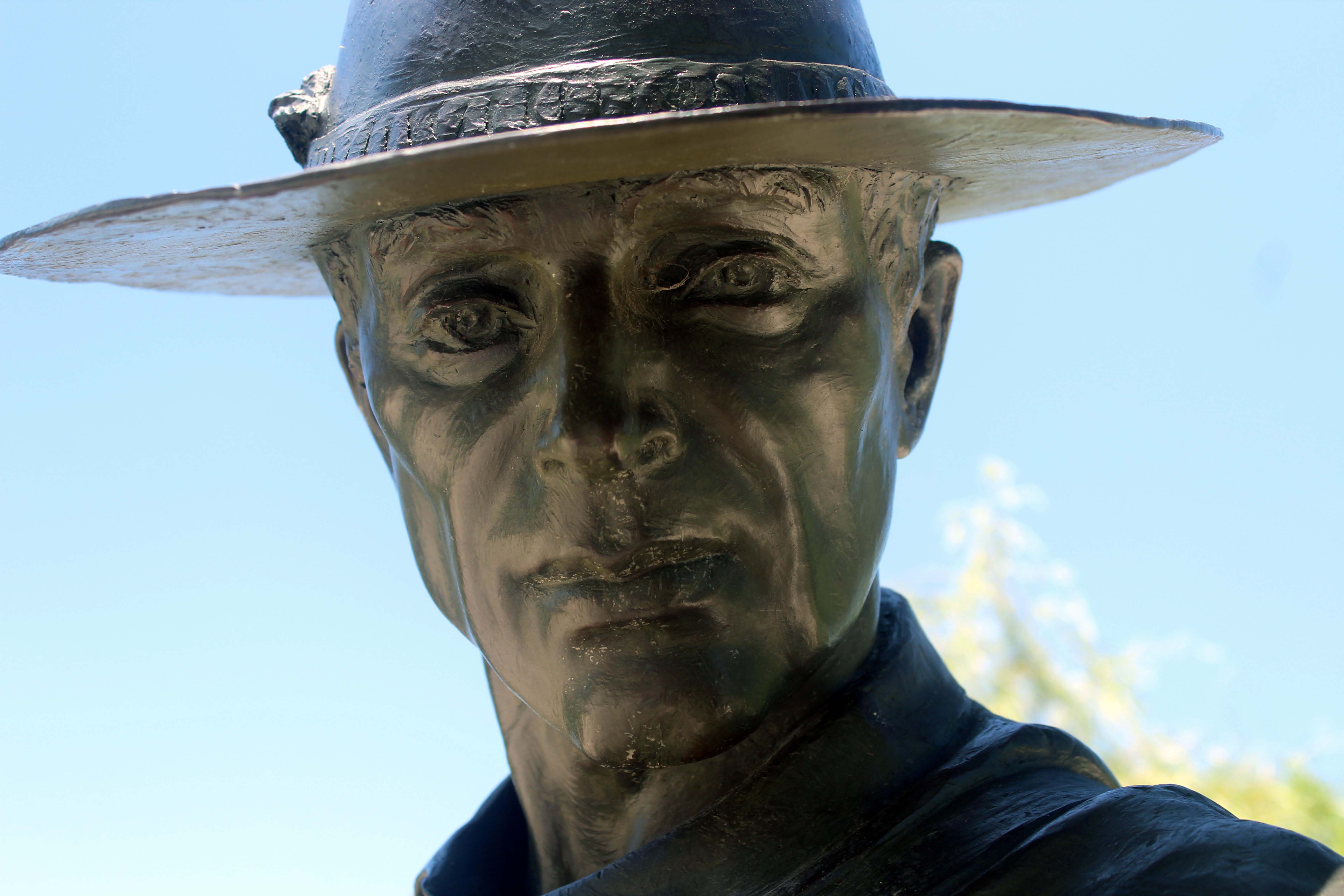
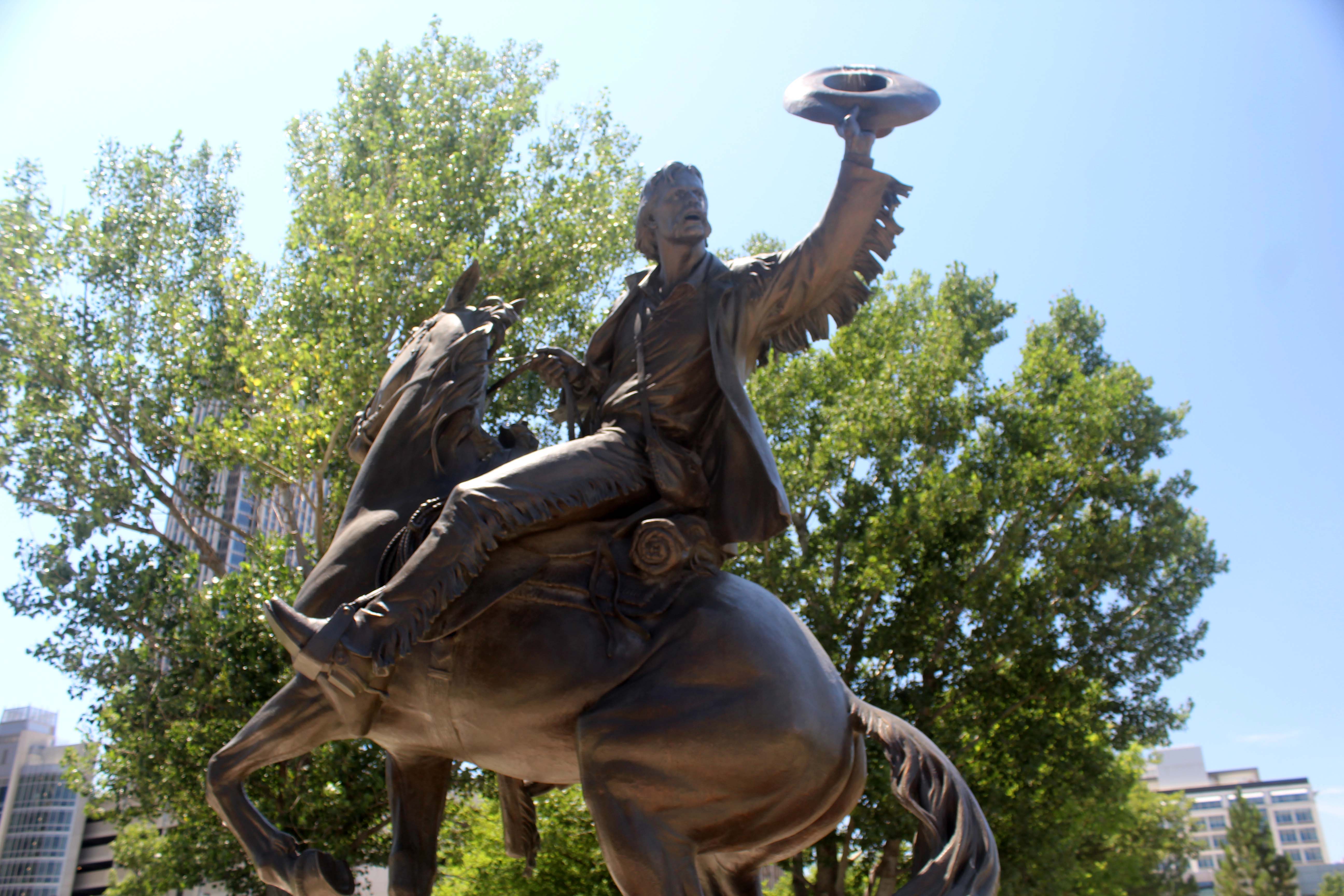
There is also a Wagon Master that stands at 11′ tall and weighs approximately 2,000 pounds. The Wagon Master served as a crucial element to wagon trains, guiding their members west and looking after the families and their supplies.
The Hunter Group portrays the constant need to provide additional nourishment and supplement the families’ meals with meat.
The wagon train is at 14th & Capitol St., along a dry creek bed, and the hunter group is driving a herd of five bison, scattering from the Pioneer Courage site and headed down 15th Street, traversing sidewalks, public planters and buildings…….
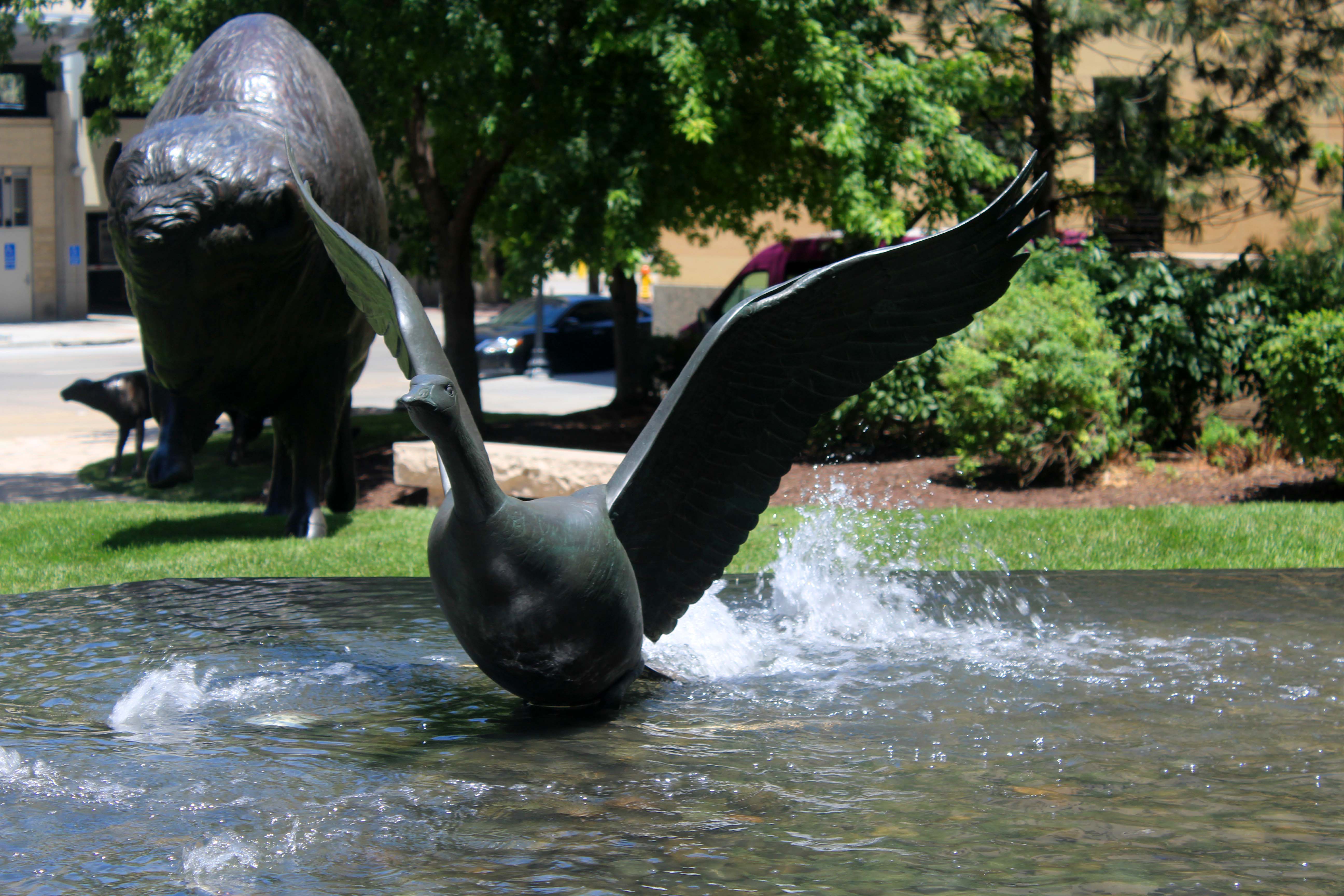
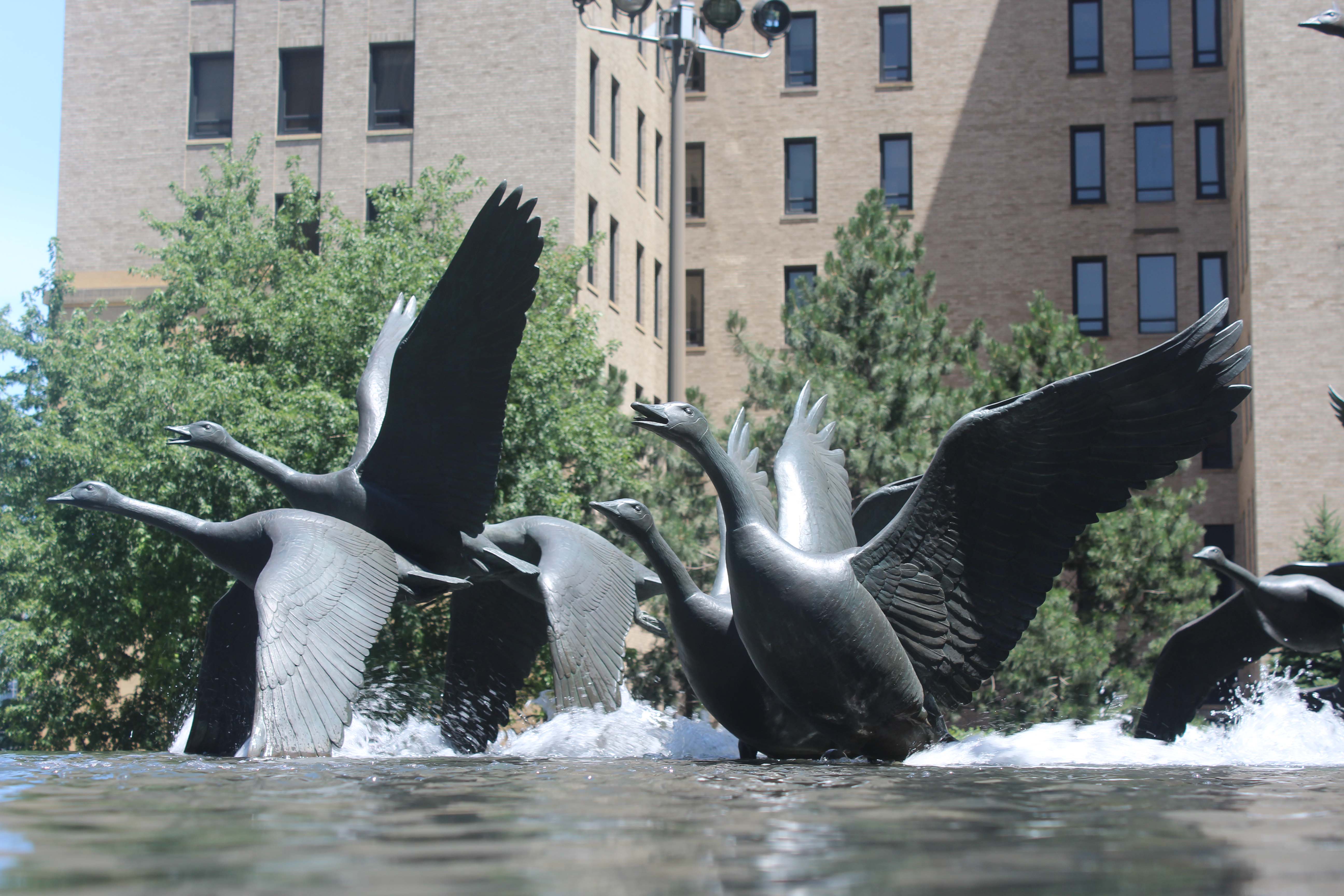
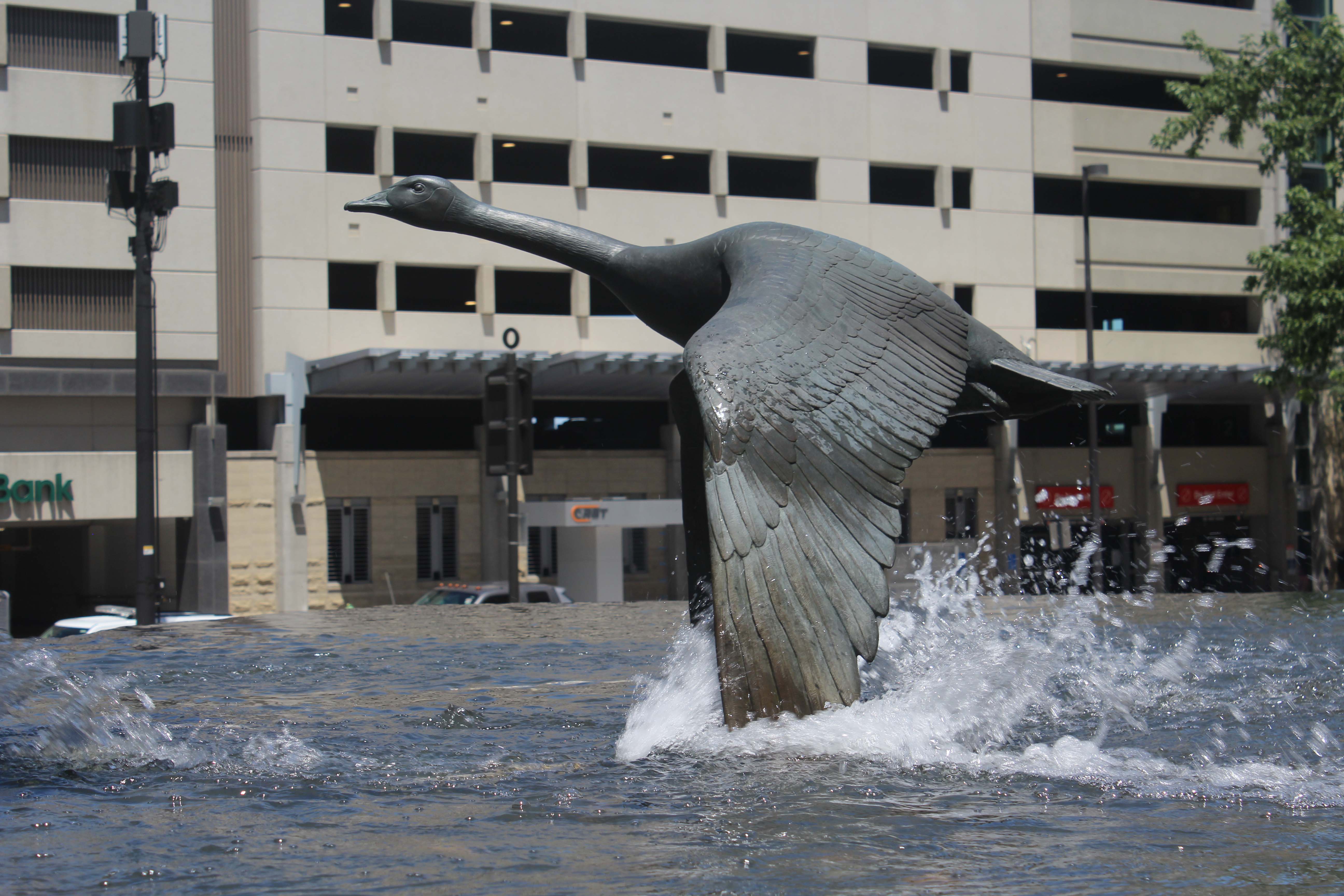
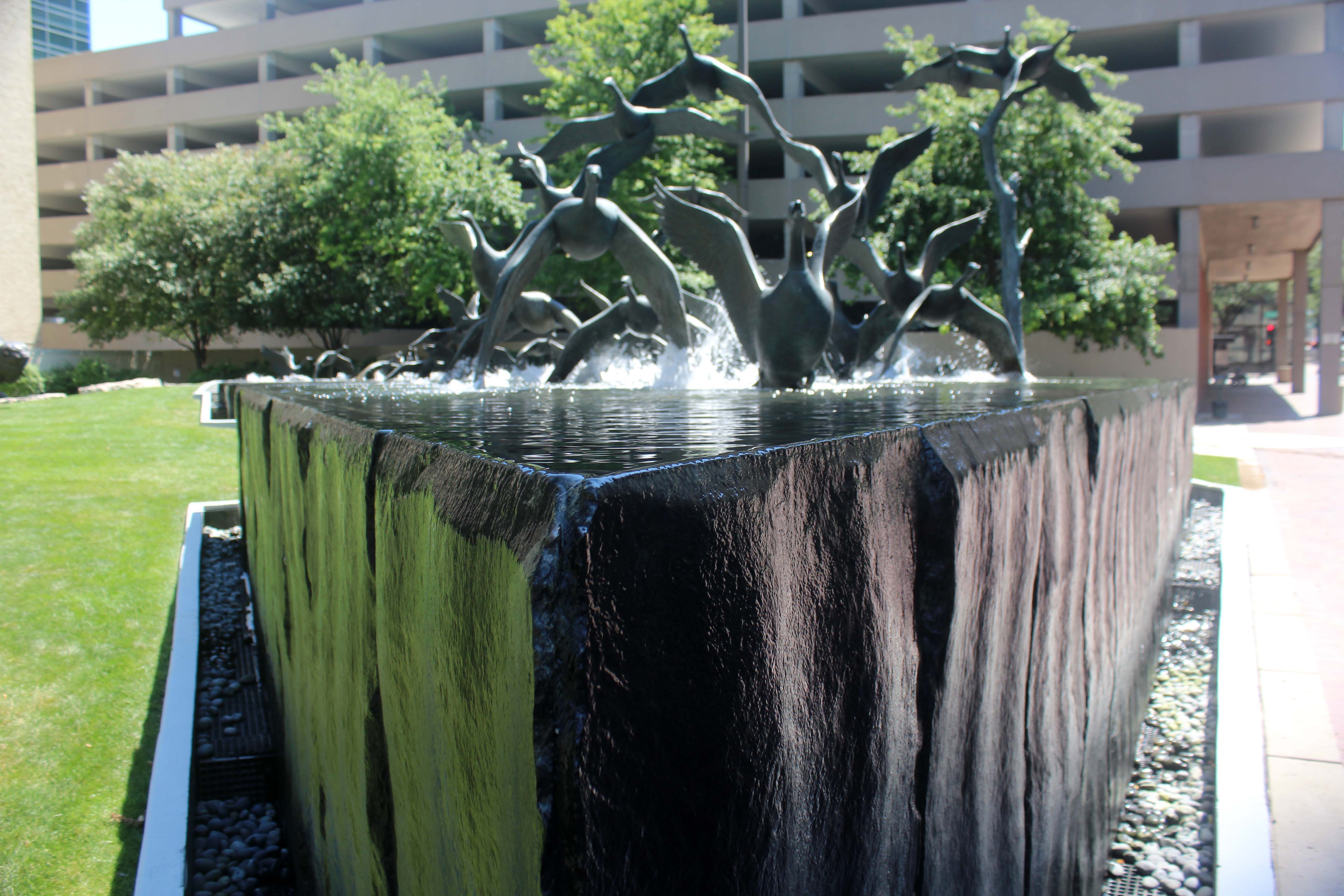
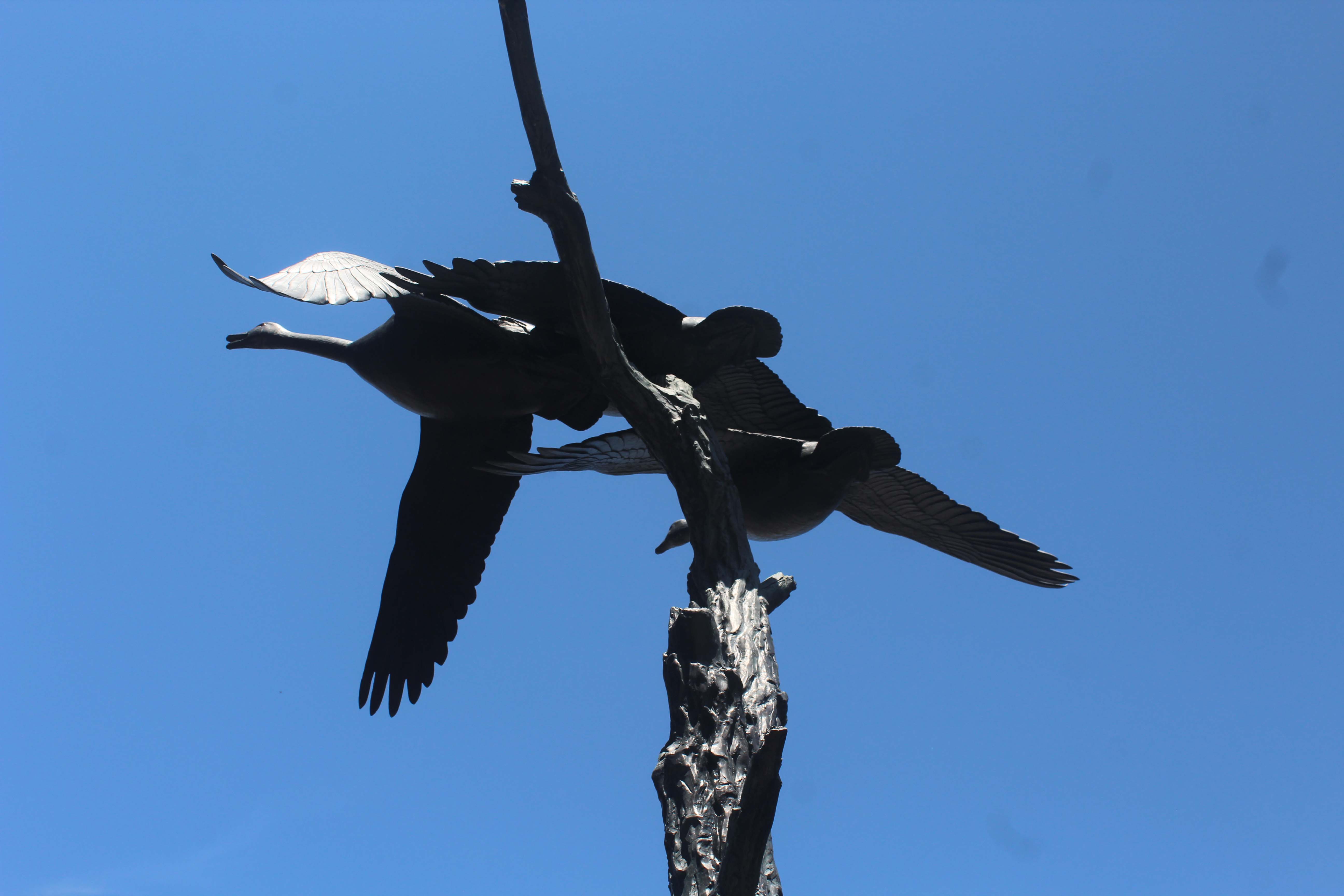
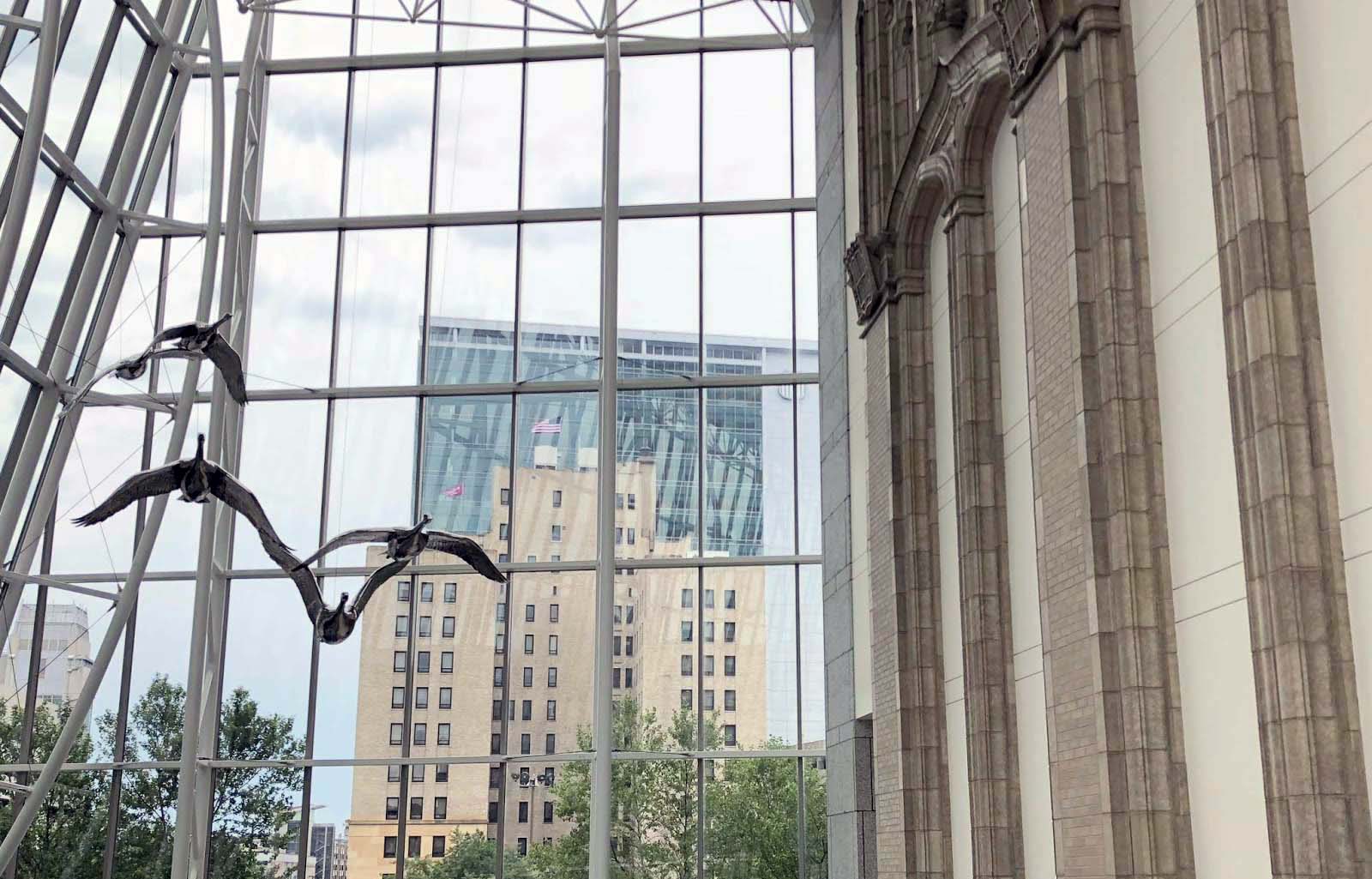
Eventually the bison before stampede onto the Spirit of Nebraska’s Wilderness Park on the Southeast corner of 16th & Dodge, startling a huge flock of geese into flight. In tandem with Pioneer Courage Park, this park features over 50 Canada geese, larger than life size, weighing approximately 200 lbs. each. The geese are cast in bronze and stainless steel – bronze alluding to Nebraska’s history and stainless steel (the metal of modernity) pointing to the future. The flight of these magnificent creatures represents the flight of geese from the industrial age to the information age.
(In the photo below, you can see how the thinner end of the “pond” is level with the ground, and the land slowly slopes away to nearly 6 feet at the other end. The effect of this is that as you walk from the small end to the large end, the geese that are fully in flight get higher and higher. It’s a great optical illusion. – Lee)
I absolutely loved how the sculptors placed little fountains at the wingtips of the geese to replicate the way the water sprays when they drag along the surface as they take off and to hide the supports holding up the geese already out of the water. Genius.
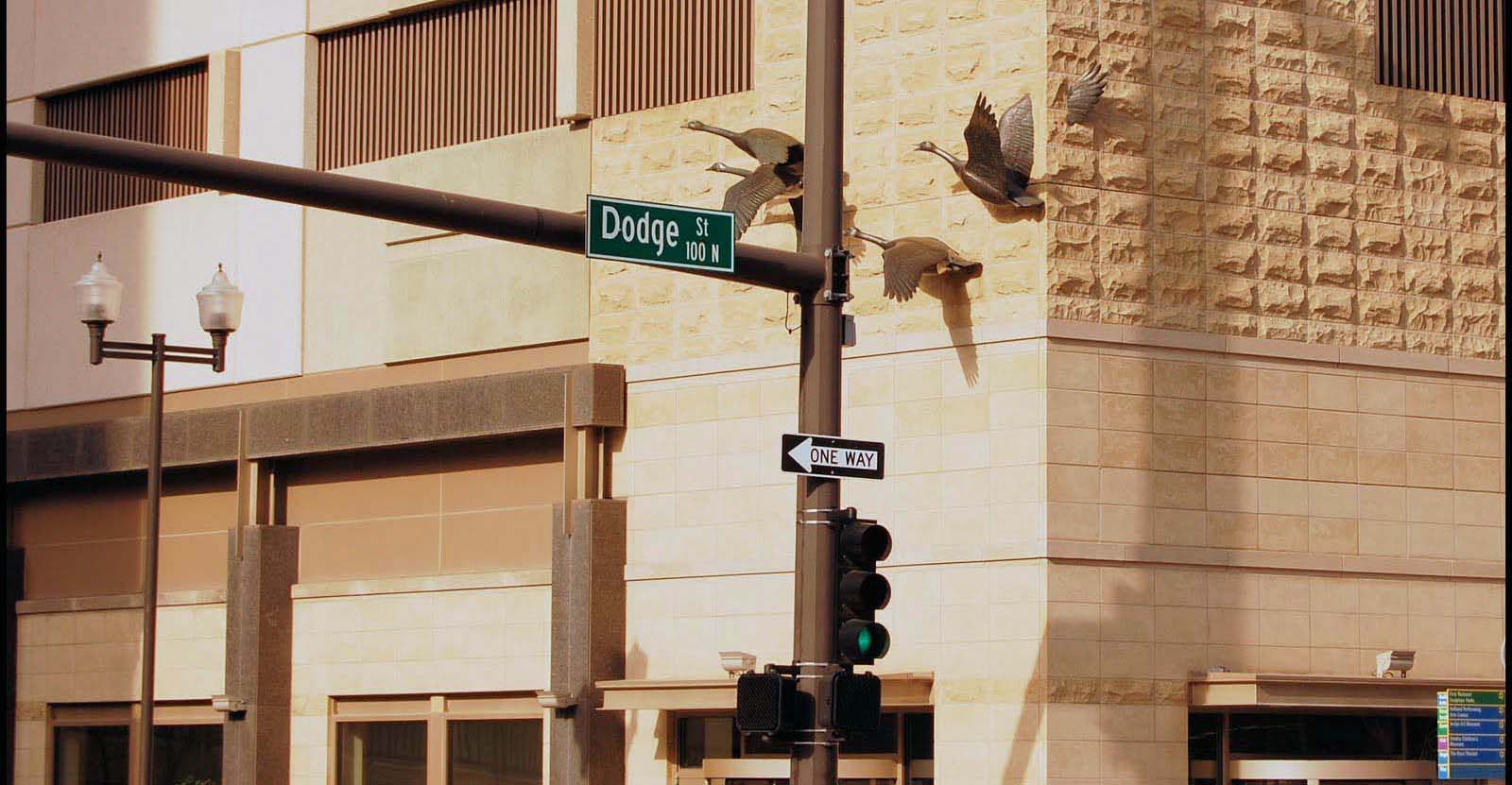
There are also geese on the closes light post to the water, which draws the eye, which further draws the eye across the street to other geese on other posts, and then to the ones going into and inside the atrium. It’s excellent theater. – Lee)
The flock continues across the street….
The geese take flight in and around the intersection of 16th and Dodge Streets, and the sculpture narrative concludes with them flying into and through the First National Tower Winter Garden Atrium.
(This is definitely in my top 5 things we’ve seen hitting the road. If it hadn’t been sooooo hot I think I would have wanted to spend a lot more time really looking at these sculptures. As it is, I would like to go back again and photograph them at night. – Lee)
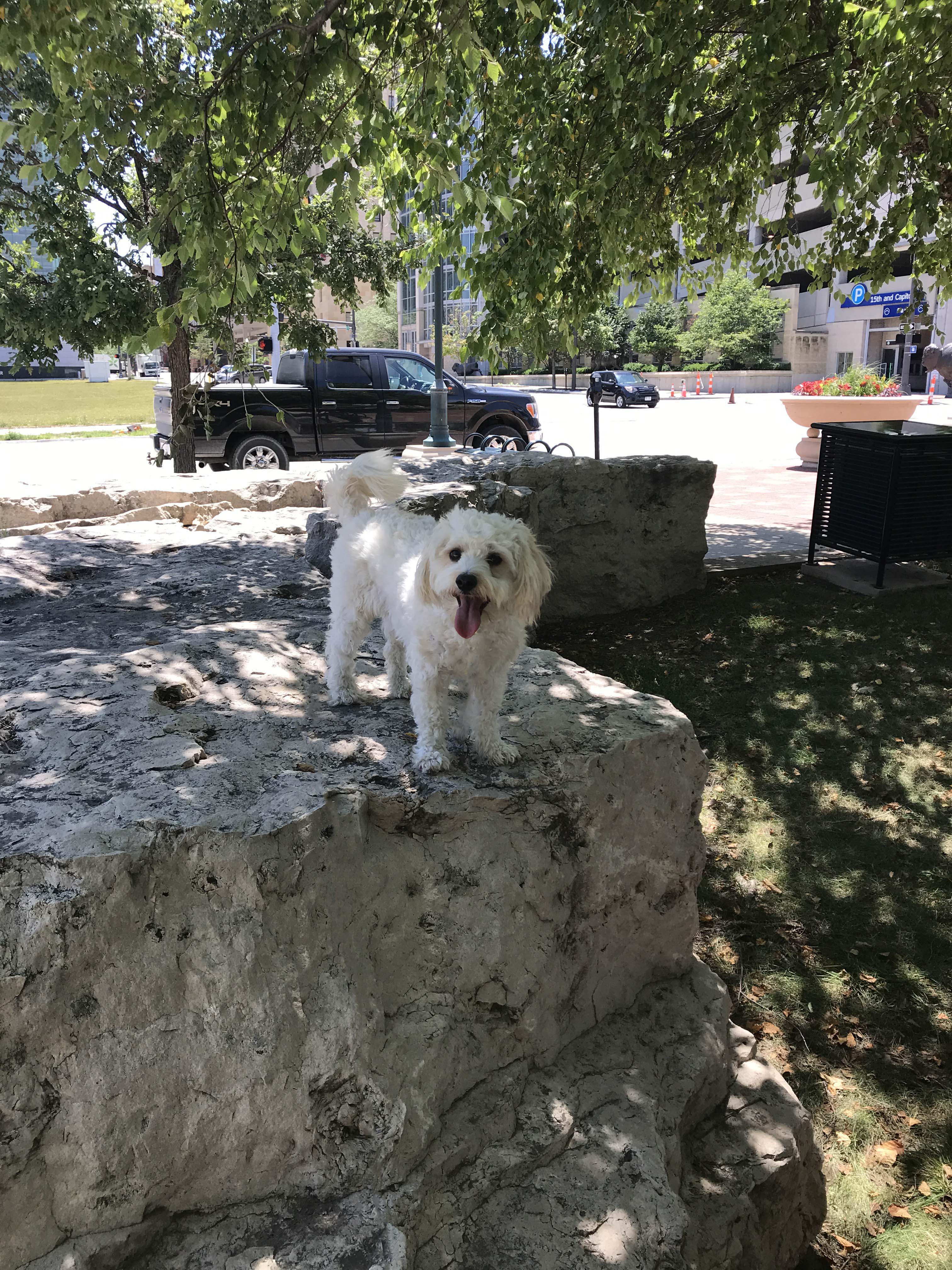
Yes it was dog friendly and Jack had a great time!
(Before anyone gets upset, Jack was on leash the entire time, I just cleaned the leash out of some of the pictures because they look better that way. – Lee)
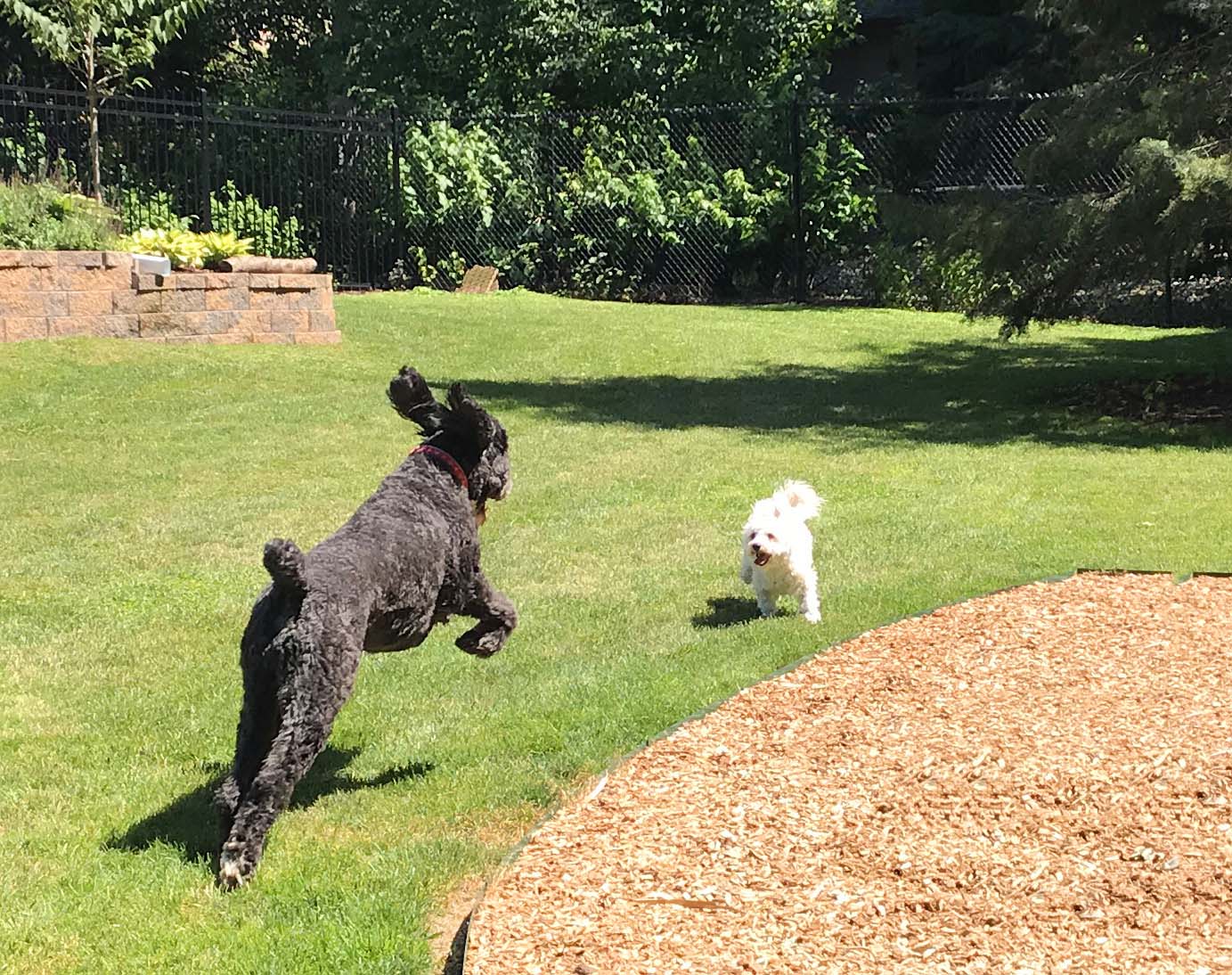
After the sculpture we headed over to Jane’s house and I absolutely loved it. They are remodeling a really cool 1960’s house and it has so much potential. It also has a LARGE fenced in yard and Jack and Gilligan (their labradoodle) really enjoyed it. Gilligan wore Jack out which was really great.
We really enjoyed seeing Jane and John and their three daughters, and learning about Jane’s charity venture. She was volunteering at the school to deliver meals and wanted to make sure their minds got fed as well. Single-handledly she started a donation program where books can be picked up for kids along with the meals. 100% of the donations go to purchasing books, and she has had wonderful success with the program throughout the summer. I know many of us wish we could do more to help during these troubled times, so please check out the Westside Foundation if you are interesting in helping. There’s a lot on that site to look at, but you can click here to go straight to the donation page. On that page, the very fist selection field is “SOLICIT CODE”. Select “Brook Brigade” and 100% of the money will go to buying books for kids.
We really appreciate seeing her and the dinner, and hope we get back that way soon when we can spend a little more time, and it’s not quite as hot and the virus is gone!
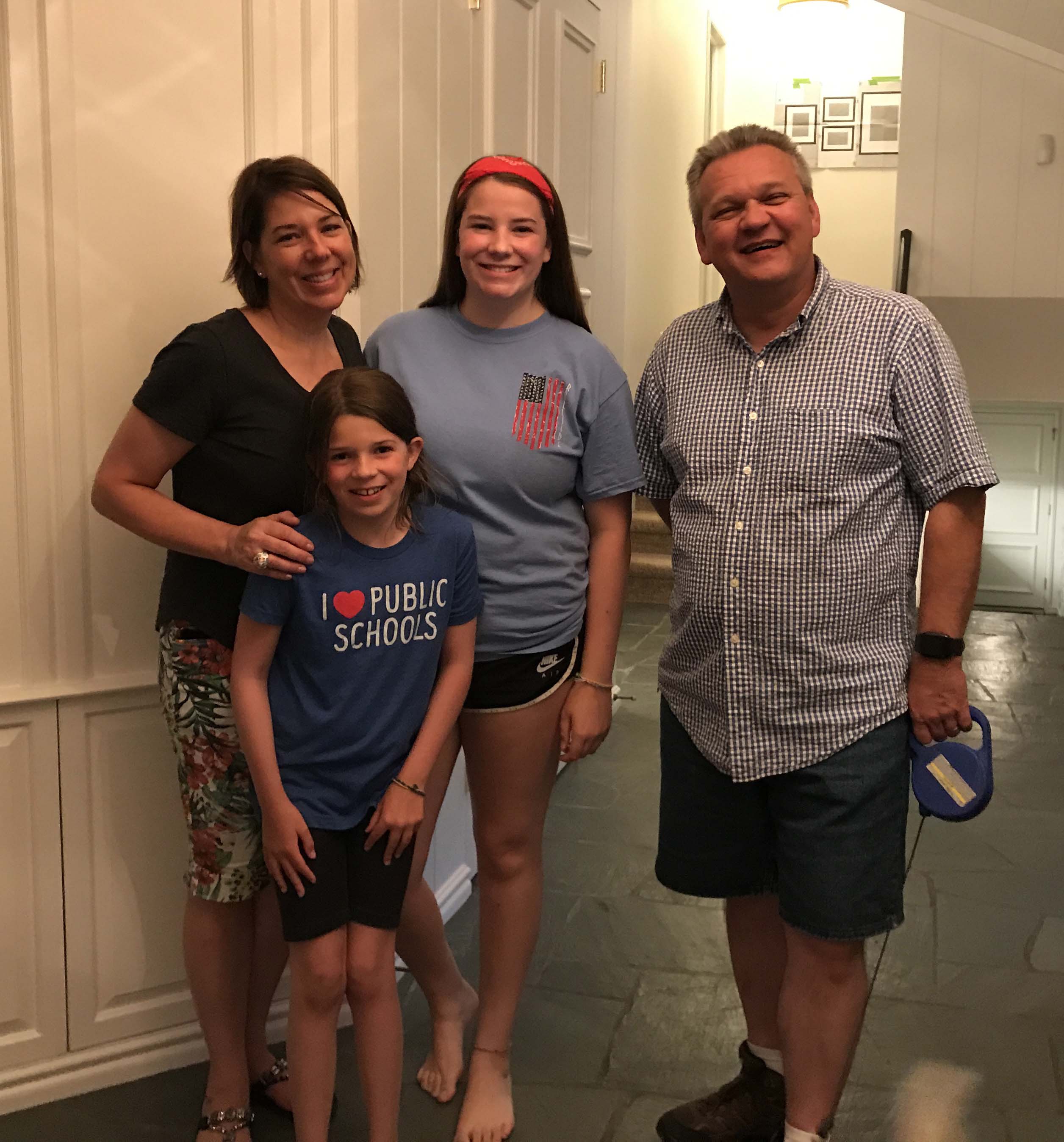
Jane, CeCe, Miranda, and Lee.
Supporting our Blog
We very much appreciate your support of our blog.
You can purchase the ebook telling the story of how we became full-time RVers.
You can purchase our recipe book filled with 80 recipes we have cooked in our RV and taste tested by Lee himself. You can purchase the kindle or paperbackversion on Amazonor buy the Apple version on iTunes.
For those of us who aren’t fortunate enough to be somewhere with a reasonable temperature and a comfortable humidity, an AC or two (or in some cases even three!) are a blessing. I know that for me they are an absolute requirement. They are also NOISY. I love the fact that the one in our bedroom is loud, because it makes excellent white noise which helps both of us sleep. In our rig, the bedroom is in the back and the AC is only 44″ from the bed, and when we run it with the AC blower set to “high”, which is always, the dB level is a whopping 68 dB. For reference, that’s about the equivalent of a food mixer. By comparison, when it’s NOT running, the room measures around 35, which is the same as a quiet library.
Our other AC is in the kitchen, but all the way at the end, so it’s right next to the living room. That puts it just a little off to the side of the chair I sit in to watch TV and movies, and it’s also pretty loud. It’s much higher, at 98″, and it measures at 68 dB as well. With the temperatures being 100° more or less every day in the San Antonio area for the the past month or so, I decided to do some poking around to see what I could do to help reduce the noise.
There are a variety of things that can contribute to why an AC is louder than it needs to be. Here are some things to check first:
Is it loose?
If the AC is not secured well, it can vibrate, and that can really make the noise louder. Check the mounting bolts to make sure they’re tight.
Are the seals/gaskets bad?
If it’s a much older unit, the rubber seal between your rig and the AC might be bad, and the rubber could have hardened, again causing vibration.
Is the fan out-of-balance?
An out-of-balance fan can make a ton of noise.
Is the airflow restricted?
Take off the inside cover and filter and look around inside the chamber. Anything that is in the way of the air flow can add noise as the air rushes past it. Try using zip ties to bundle wires together and secure them off to the side away from the air flow. You can also use furnace tape to secure anything and create a smooth surface for air to flow over.
If you’ve done all the inspecting and everything you can to make sure that it’s not making more noise than it’s supposed to, and you still want to it to be quieter, you can either buy an AC “silencer kit” or make one yourself. I took a look at the pre-made kit and decided that it was way too much money for a big piece of plastic, and decided to try making my own. For those with money to burn, who don’t want to, or can’t make one, here’s a link to the manufacturer:
Before we go any further, I want to point out that both the commercial product above, and my version are designed to work with AC units that have the “standard” interior ceiling cover that consists of a grill that has holes or slots for air intake, and in some cases a “dump” valve. A dump valve allows you to “dump” all of the cold air directly from the AC unit straight down and out into the room, as opposed to directing that cold air throughout your rig via ductwork. I also want to mention that the “Wacko Products” version removes the option of using the dump valve, but my mod does not. You can still use the dump valve with my version.
The commercial version essentially works by offsetting the air intake to the side by about 50%, reducing the open area, and adding some noise dampening material. It seems to look pretty nice and there are plenty of people out there who have made videos and reviewed it. I have not owned one or tested it, so I cannot endorse it. You should thoroughly research it before you spend the money. Do some Google searches and watch some videos and definitely read reviews. It’s a pretty good chunk of money to spend to not be happy with the end result.
(We started with the idea of buying one and when Lee showed me the video I personally didn’t think the noise reduction in the video was worth $189. Of course I don’t sit in that particular seat and the AC noise is much less of a problem where I do sit. If Lee really wanted it of course we would have tried it, but I love when he puts his MacGyver skills in action. – Trace)
If you’re comfortable tinkering and want to try making one of your own, here’s my frugal version. It really not at all complicated, and also relatively inexpensive.
Here’s a material list. I measured the interior AC cover and added an inch or so on each side for the dimensions.
$ 14.88 – 8′ primed 1″x 4″
$ 9.41 – 2′ x 4′ luan
$ 21.56 – 4′ x 8′ white polywall panel (in the paneling section, and matches most ceilings in rigs. It’s the most expensive part of the project, so you could just use the luan and paint or stain it)
$ 4.69 – 2 2″ hinges
$ 1.79 – magnetic catch
$ 7.88 – furnace tape
$ 8.98 – white gorilla tape (if you don’t have gaff tape. Why don’t you have gaff tape? I have been telling you to get some for years.)
$ 13.56 – 1″ x 1″ poly outside corner molding
$ 11.94 – 4′ x 8′ x 1/2″ foam insulation board (I used some leftover carpet padding, you can use almost any sound dampening material)
If you don’t have any of the materials, and you have to buy everything it will cost $95. If you want to be more frugal, you can skip the metal tape/gorilla tape and use duct tape. You can also skip the poly wall sheet and use some old rolled up t-shirts or other fabric as the sound insulation. Those changes will lower the cost to less than $50.
I chose these materials after making a “proof of concept version” with what was lying around, and decided that instead of something that would need to be stained or painted and color match I would just go with white and hope that it would blend in.
(The “proof of concept” was heavy, clunky and pretty ugly. As much as I appreciated the initiative, I really didn’t like the way it looked. Lee quickly reassured me that the final version would be lighter and prettier which it was. – Trace)
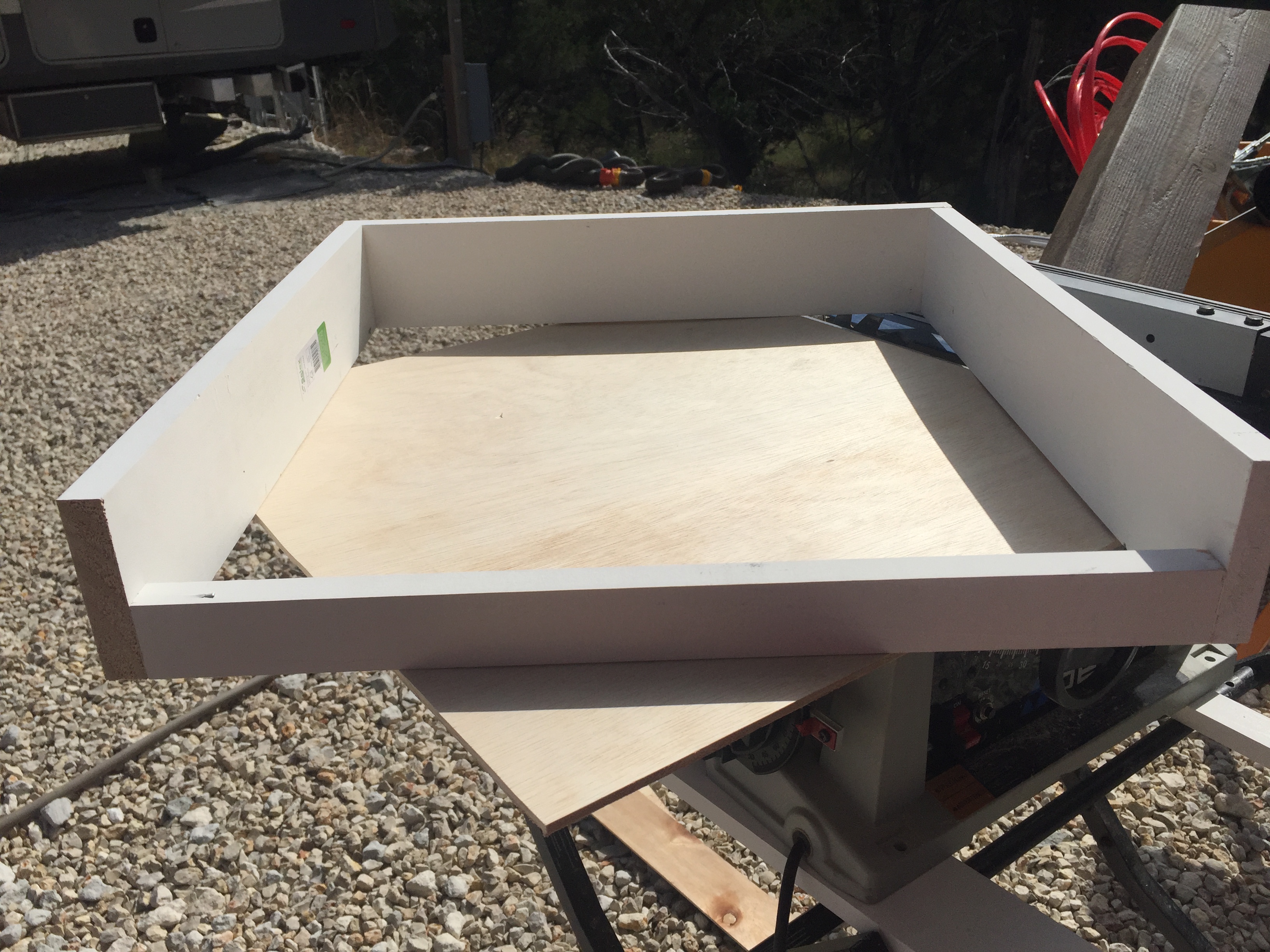
The construction is very simple, it’s just three sides of the 1″ x 4″ assembled with finish nails and then I added a 1″ x 1 1/2″ piece which as you can see leaves an opening for air to enter.
Then I attached the sheet of luan, added the layer of textured plastic sheeting and miter cut the corner trim.
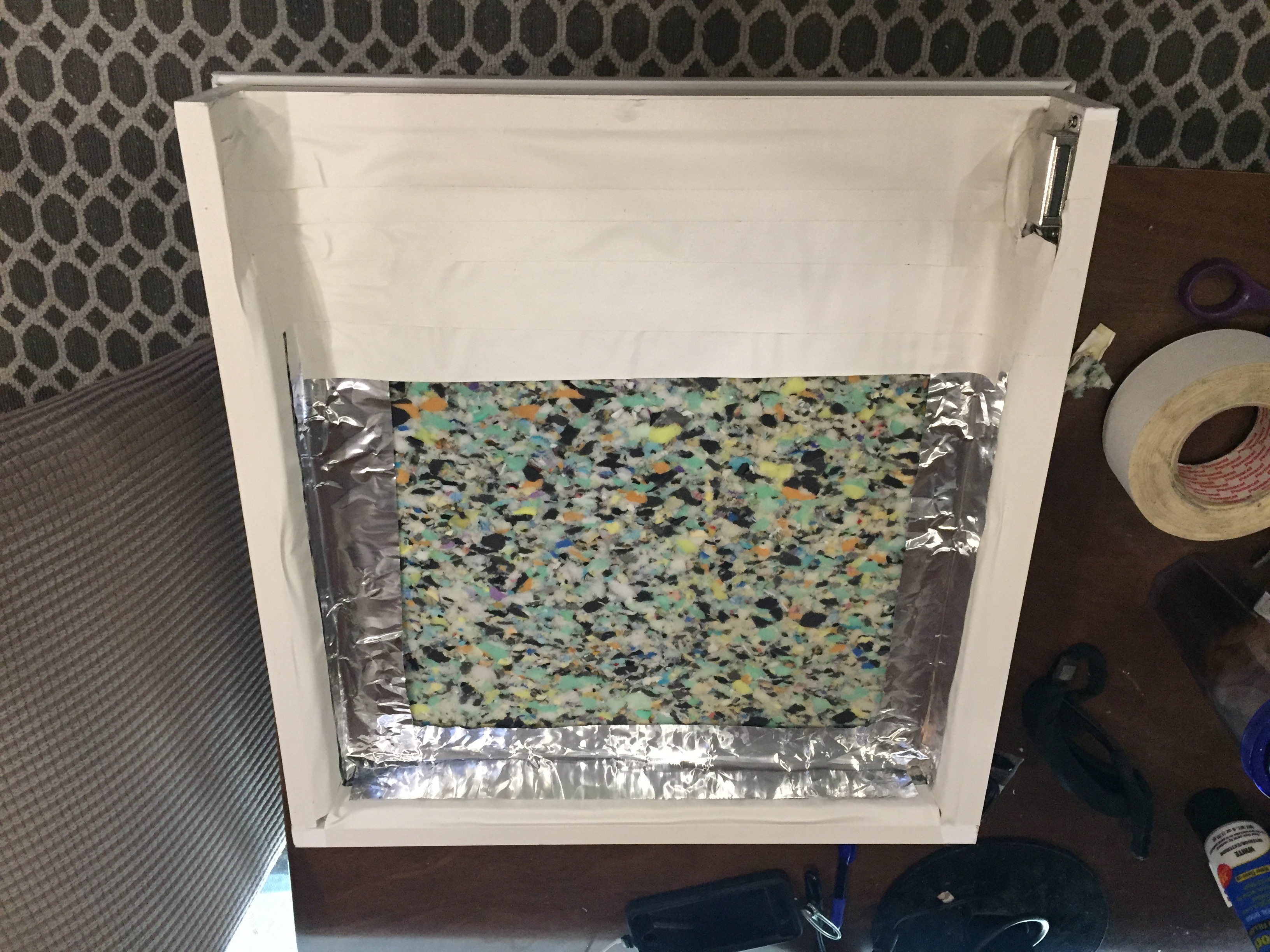
I flipped it over and added three layers of 1/2″ carpet padding. The white area you see at the bottom is the white Gaff tape. I wanted to use that instead of the metal furnace tape at the entrance because I wanted to see if the rough texture of the gaff will “catch” any airborne particles before they hit the grill and filter. I thought maybe the smoother furnace tape wouldn’t catch them. I don’t think it matters what you use, as long as it holds the material in place. You could also use pretty much any sound dampening material inside. I used carpet padding because I already had it, but you could use foam, towels, blankets, insulation, anything that will absorb and dampen sound. You can also see the metal magnetic catch in the lower right corner.
Once it was all set I added the hinges.
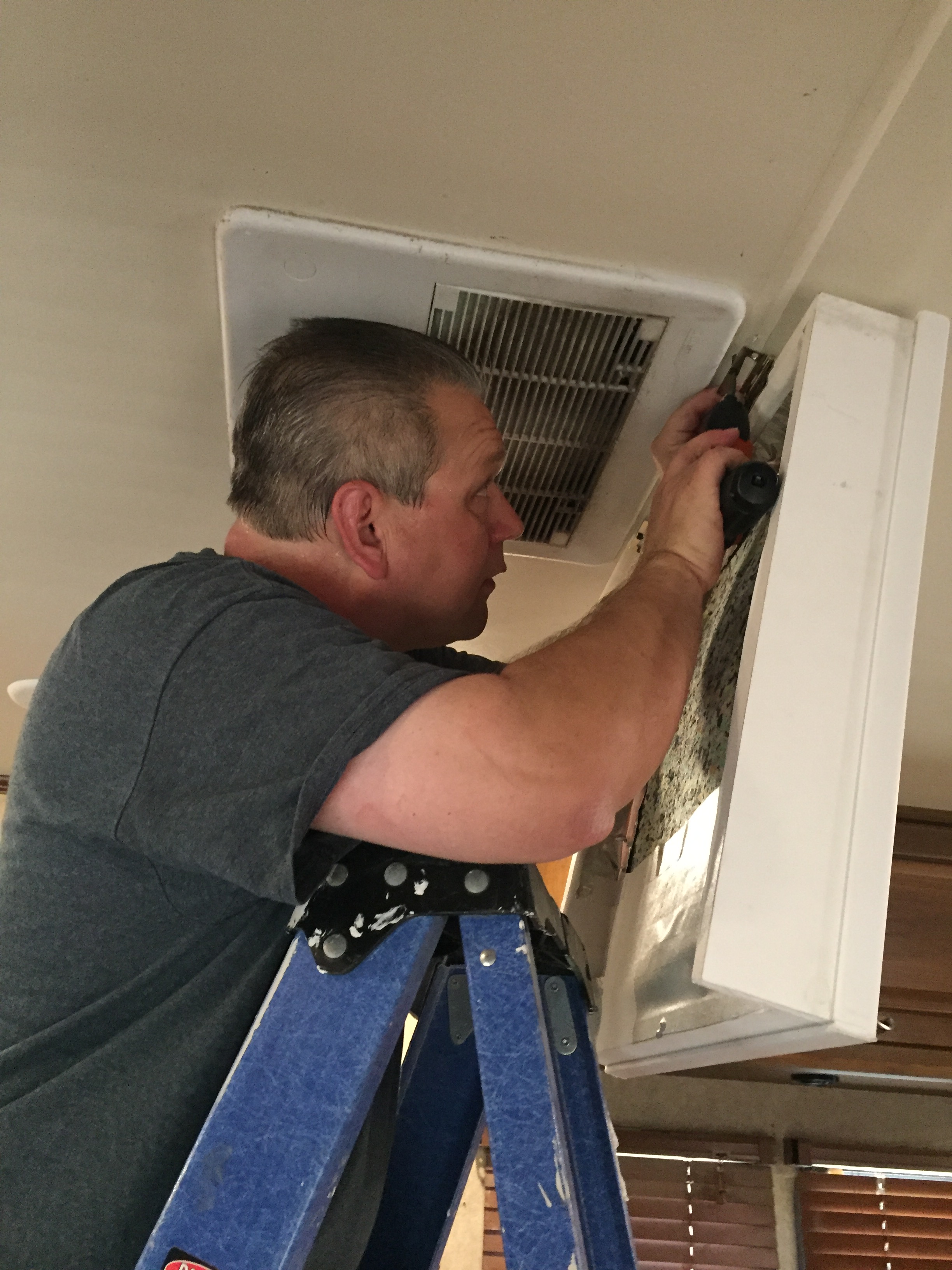
Then I hung it up. Most rigs will have some wood framing around the AC hole in the ceiling, but check to be sure, otherwise the screws will just fall out of the thin paneling of the ceiling. Also be sure to avoid hitting any wiring with the screws. Use the shortest screws you can, and make sure you’re going into wood and that will keep you out of trouble with the wiring.
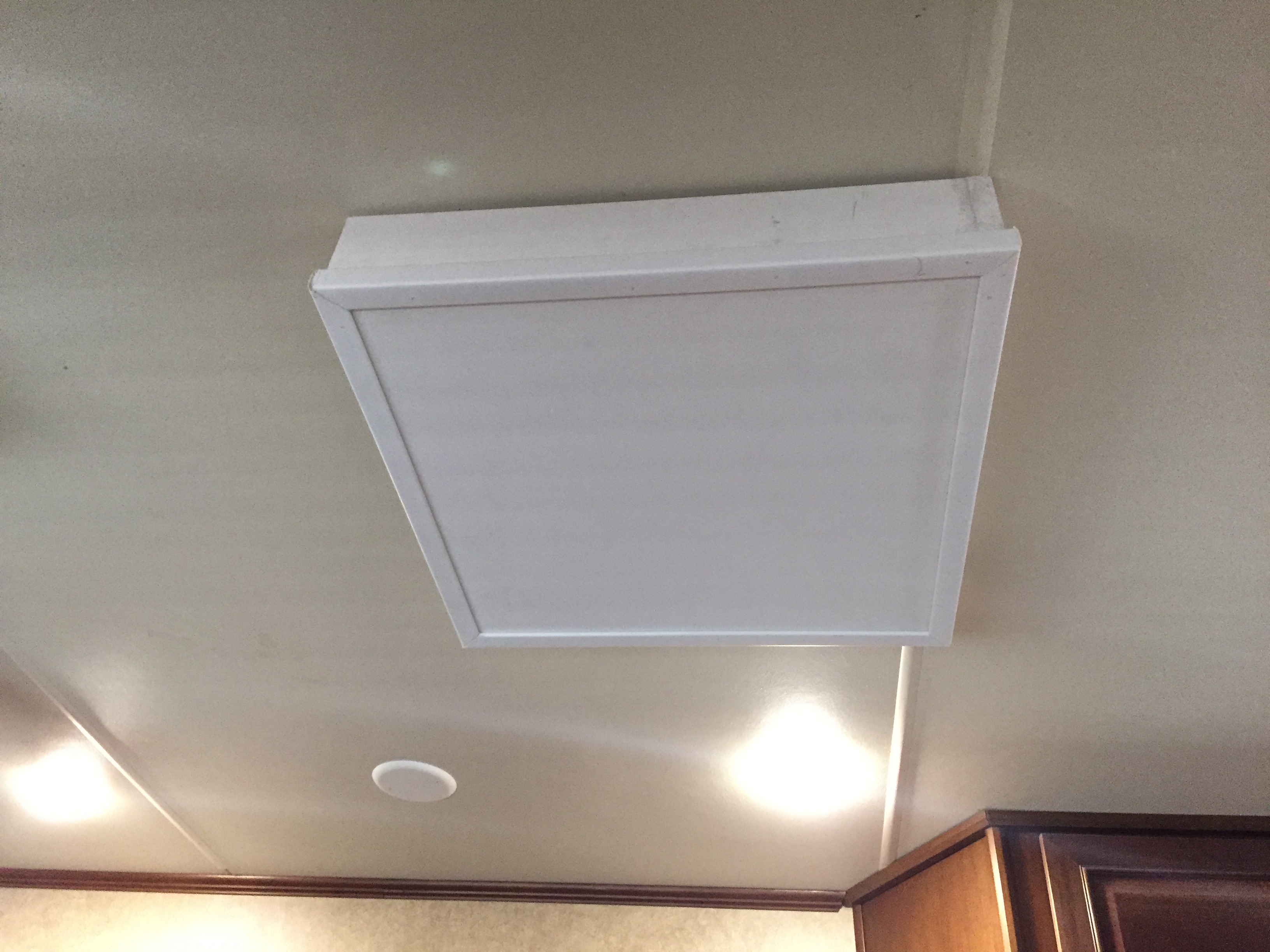
Finally it was just a matter of attaching the metal plate to the ceiling for the magnetic catch, and swinging the box up on the hinges and letting the magnet hold it in place.
See pretty 🙂 – Trace
Although we drove 1200 miles with this in place, the magnet never pulled away from the metal plate. But even if it had, it would just swing harmlessly down. When it’s “closed” the bottom of the box is 92″ from the floor, which is plenty of clearance. In our rig, when it’s “open” it’s still 75″ from the ground. And because it can be opened, the “dump” valve is still available to us, which is nice.
Lee grabbed me last minute to do the demo. I am a bit of a mess 🙂 – Trace
After installation, it was time to check the sound level! From the same position as before, with all other factors being equal, the meter gave us a reading of 62 dB, for a net reduction of 6 dB!!! This might not seem like a lot, but it is a massive amount. The decibel scale is logarithmic, not linear. This simply means that for every 3 decibels you move up or down the scale from 0-194, you are adding or dropping 50% of your remaining sound pressure levels to your exposure. By dropping 6 decibels, for instance, you first move 3 dB, and then another 3 dB. For each 3 dB you drop, your sound pressure levels will drop another 50% of the remaining sound pressure. The following table will help illustrate the order of magnitude associated with dB:
dB-Drop Survival Rate
1 dB Drop 79% of your noise has survived
3 dB-Drop 50% of your noise has survived 6 dB-Drop 25% of your noise has survived
9 dB-Drop 12.5% of your noise has survived
10 dB-Drop 10% of your noise has survived
20 dB-Drop 1% of your noise has survived
30 dB-Drop .01% of your noise has survived
So for our purposes here, we reduced the sound level 75%! That is a significant amount of improvement, especially considering I spent about two hours and $ 100 on it, and now I can watch TV without sitting in a pool of my own sweat and turning up the volume to absurd levels.
(For those non-techy, non-math geeks like me, essentially it was quieter when you stood directly beneath it. In other areas of the room, it didn’t seem to make a huge difference but directly underneath absolutely. Since the chair is almost directly underneath it, it will certainly make Lee’s life more pleasant. From my perspective it was relatively cheap, Lee had lots of fun making it, and it looks like it came with the RV. Those are my criteria for a good RV Mod! -Trace)
Supporting our Blog
We very much appreciate your support of our blog.
You can purchase the ebook telling the story of how we became full-time RVers.
You can purchase our recipe book filled with 80 recipes we have cooked in our RV and taste tested by Lee himself. You can purchase the kindle or paperbackversion on Amazonor buy the Apple version on iTunes.
Because of COVID we stayed in Texas for six months and we were both incredibly grateful to our friends Cori and Greg for providing us a safe haven. We were both ready to start traveling again, and unfortunately COVID cases have surged and we were both nervous about traveling. Lee got a summer gig, so we needed to travel from Texas to Minnesota with a quick stop in Omaha so we could see a friend.
Neither one of us was quite sure how it would go but the only way to find out is to do it, so we set out on Tuesday and headed north. This is an account of that experience and please keep in mind your opinion on traveling right now could certainly vary. For a different perspective, please check out our friends Deb and Steve’s blog.
On our first travel day we hoped to get near Forth Worth, and we were pleased that we made our goal. Since it was incredibly hot, we really needed full hookups and 50 amp power, so we ended up stopping at the KOA Sanger-Dentonwhich was close to the highway. I called ahead to make sure they had a spot and paid over the phone. Because we arrived before 5pm Lee had to go into the office to get the paperwork and he donned a mask prior to entering.
When Lee walked in the office no one had a mask, and he was checked in by Cecil, who was an older work kamper in his 60s. Cecil informed Lee that he did not need to wear his mask because Cecil had had pneumonia in 2014 so he had the antibodies to protect him against COVID. He then told Lee that if Lee got a pneumonia shot then he would be immune to COVID. Lee wisely said nothing but got out of the office as quickly as possible. On the plus side the sites were long and level although we chose a gravel site because it was $10 cheaper. The site still cost $40, but we definitely needed 50 amp. It was 94 degrees and the site had no shade so it took a few hours to cool down the rig.
The next day we looked forward to finally getting out of Texas (it’s a BIG state) and left with the goal of making it to Wichita. Lee was trying out a new TSD Logistics gas card program (future post dedicated to this), so we avoided our usual Pilot and Flying J truck stops, which is our go-to, and tried out other truck stops. Our first stop was a TA in Oklahoma City and when I went inside not one person was wearing a mask. They only had an Iron Skillet for food, but they were short staffed and the takeout took over 20 minutes.
Our original plan was to eat in our rig as we traveled, but with temperatures in the high 90s it would be too hot so we did takeout instead and ate in the cab of the truck. The food was good, but I was absolutely uncomfortable waiting for it as many of the patrons were giving me looks as they sat at the tables and ate. (It’s a little surreal to be the only person wearing a mask and getting dirty looks. I can see how someone would choose not to wear one, but I can’t understand why anything would think that someone else wearing one would be a problem. But, people are awful, so there’s that. – Lee)
We finally made it to Wichita and stopped at Air Capital RV park . Once again 50 amp came at a premium as these sites were $60 (minus $5.90 for Good Sam discount) for a pull through. Despite the prices and utilitarian nature of the park it was almost full, so we were glad we got a spot. Once again Lee went inside to pay and although there was a sign on door stating masks were mandatory, none of the employees were wearing one. At least Lee didn’t get a lecture this time, but once again he got out of the small office as quickly as possible.
These sites were incredibly hot and temperatures in the rig were 95 degrees. Despite the 50 amp it took hours to cool down and the poor puppy was cooped up because it was too hot to walk him for long. They did have a nice long pet area along a fence, but shade was minimal and the heat was extreme. The best part was a KFC was within walking distance, so once the sun was partially down I walked up and got myself some chicken. That was excellent!
We went to bed pretty early trying to get an early start, but around 4am the dog started barking. This is incredibly rare and we woke up a little disoriented with the dog barking and the rig shaking. My mind registered it was Kansas and the possibility of tornadoes, but I was so tired I just went back to sleep. Lee got up with Jack and he went outside to put down the stabilizer jacks and because the temperature had dropped around 30° he decided to take Jack for a walk and they had an awesome time running around outside with huge wind gusts and cooler temperatures. Jack is a great traveler but he wasn’t getting his usual exercise so that was really great.
When I got up it was raining and there was some lightning but no more heavy winds. We left and were both really grateful for the cooler temps. That gave us more options which was a good thing, because our next stop was a truck stop on the turnpike in Emporia Kansas. Despite the sign stating everyone had to wear masks per the governor, 50% of the patrons didn’t have them and many of the employees were missing them or had them pulled down. The rig was cooler though so we could use our own bathroom and eat leftover chicken in the RV at lunchtime.
Finally we made it to Omaha and since we were staying two days we decided to try a county park. They had 50 sites for $16 each with first come first serve spots. Since it was relatively early in the day we thought we might get lucky. Unfortunately, they only had two openings and two people were already in line so I called the KOA. It was $62 a night but more importantly they only had one night open. We could drive to other first come first serve county parks, or try the walk-ins at the Eugene T. Mahoney State Park. They were booked for reservations but had lots of walk ins so we decided to give that a try. It was getting later which was pretty stressful but thankfully they had lots of openings. Plus every single person was properly masked in the office and the 50 amp electric sites were only $30 per night. We did have to pay an additional $8 per day out of state visitor fee but $38 was a bargain at that point.
The campground was an older one with mature trees and beautifully kept sites. The only downside was the roads were a little tight for our big fifth wheel, but Lee was careful and managed. We stopped and took on fresh water at the dump station near the entrance and then navigated the tight turns to site 93. It was a beautiful long site, but Lee simply could not back into it. Thankfully site 91 right next to it was open and Lee threaded the needle on the first try. The site has lots of shade, beautiful mature trees, and is super deep. Absolutely lovely and the RV cooled down in no time with the shade. The puppy was in heaven with real grass and happily scampered around on our many walks. Since it is a shaded park I could walk him all times of the day and he was very happy.
Fantastic deep site
They had a pond with paddle boats for rent
Loved the huge , mature trees
Jack was loving it
Next up I will talk about exploring Omaha. Almost everything we were interested in was closed, but there were a couple of things that were open and we made the most of them!
Supporting our Blog
We very much appreciate your support of our blog.
You can purchase the ebook telling the story of how we became full-time RVers.
You can purchase our recipe book filled with 80 recipes we have cooked in our RV and taste tested by Lee himself. You can purchase the kindle or paperbackversion on Amazonor buy the Apple version on iTunes.
Hitch itch is definitely a real thing. It’s that feeling us travelers get when we are stuck in one place for too long. But in today’s environment it feels selfish, if not outright dangerous, not to think carefully before we change locations. Initially our plans were to head to Charleston for our grandson’s birthday party, but unfortunately South Carolina is in a full Covid tailspin right now, and both of his parents work in the restaurant industry. Then we talked about going to see our daughter in Minneapolis and even scored a hard to get site at a nearby campground. Unfortunately despite more rigorous restrictions there the kids both work in restaurants as well and again after long discussions with them they felt it was too dangerous.
That left us unsure what to do. We could stay in Texas, but as temperatures are 106 well before noon at this writing, we really wanted to find a place somewhere north. After much discussion, we thought Lee could look for a seasonal job which would provide us a place to stay and a new area to explore. We have never looked for a job mid season and weren’t exactly sure what we would find. Thankfully there are always opportunities, and within five hours Lee had found a job, had the interview, and was made an offer. We are both excited because the job does not involve working with the general public and is in a small town in Minnesota. It is three hours away from my daughter so if things do calm down we will be able to see them.
I was worried about what opportunities we would have given the state of things, but am pleased to report there are always jobs out there. This one even pays well, and has the opportunity for overtime. Perfect really for what we need. Which leads me to answering a question that a reader asked. We love answering reader questions by the way, and you can feel free to email us at camperchronicles@gmail.com anytime. Here’s the question:
If you two were starting now or for anyone who is starting in 2021 based off the knowledge you have:
Would it be better to wait? Personally I would wait. There is a ton of change associated with the first six months of the lifestyle and I don’t think I would want to throw a COVID world into that. I tend to be risk averse though. I imagine Lee feels differently – Trace.
I think it depends on your primary motivation; in general I don’t think other people are the best barometer of what makes ME happy. But if it were me, I don’t think I would wait. I think the virus is coloring things a little, so if you want to wait a few months and see if things get better, then do that. – Lee
Would it scare you too much? Absolutely. It was a huge leap for me. Again I am sure Lee feels differently. – Trace
Nope. I tend to figure out the things that I am worried/scared about and then address them. If I can’t address them, then I try to minimize them. I am extremely risk averse, as well, but I also know that nothing ever happens without eventually taking that first leap. – Lee
Are jobs still there and are they just as good today? Thankfully yes. I actually think they are better. As the baby boomers get older many are leaving the lifestyle which opens up more job opportunities. The pay is better and the environment is changing for the better imho. – Trace
There are ALWAYS jobs. Every day I get 5-10 emails from Work Kamper News from places that have immediate openings. Someone either never showed up, or they came and left. There are more camphosting jobs than anything else, but the other stuff is out there. – Lee
“Anything” you and Lee can offer I would value. I would never want to discourage anyone from the lifestyle, but timing does matter. If you are in a situation to hold tight until there is a vaccine that would be my choice. The other situattion that would have worked for me was if I was going into a long term work kamping situation. That would give you time to settle into living in an RV and keep you in one location for awhile. – Trace
Hoo boy, “anything” is a big word, and the spaces between the letters are infinite. If I could go back to me in 2014 I would tell myself a few things: don’t skip over something because you might get to it later. That usually doesn’t happen. So take every opportunity. I would also tell myself to try and leave as much baggage behind as I could, and get rid of as much I could as I went along. Wherever you go, there you are. – Lee
Hope this helps and take care.
Supporting our Blog
We very much appreciate your support of our blog.
You can purchase the ebook telling the story of how we became full-time RVers.
You can purchase our recipe book filled with 80 recipes we have cooked in our RV and taste tested by Lee himself. You can purchase the kindle or paperbackversion on Amazonor buy the Apple version on iTunes.
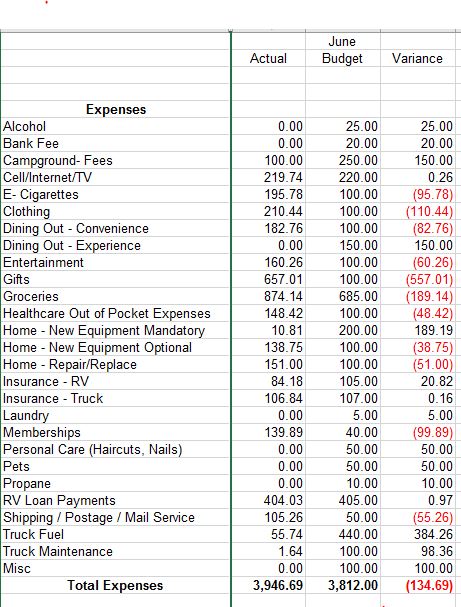
The only good thing that has come out of Covid is Lee and I have been able to save some money. After several months we have managed to put $9,000 in savings and still buy gifts for lots of people we love. We are finally starting to travel in July, and things will change, but we will have some additional income to offset those costs. More on that in a post in the near future. As always for more details see below.
Clothing – Lee bought a new pair of shoes and I bought some pajamas. My old ones were six years old and literally falling apart 🙂
Dining Out – It’s nice to be in budget in this category. It’s all pizza, fast food etc. It’s one of the few ways we can treat ourselves.
Entertainment – Books, books, and more books!
Gifts – We bought presents for so many people this month and donated to the Center for Policing Equity through a program at my work where they matched the donation 100%.
Home Repair – Unfortunately we had to buy a new ice machine. The last one only lasted 6 months which really bummed us out. On the other hand, it runs nonstop from when we wake up to when we go to bed. An ice machine is just not something we are willing to do without though.
Truck Fuel – Love love seeing these low costs.
So that was the month. Lots happening soon will see how that goes.
Supporting our Blog
We very much appreciate your support of our blog.
You can purchase the ebook telling the story of how we became full-time RVers.
You can purchase our recipe book filled with 80 recipes we have cooked in our RV and taste tested by Lee himself. You can purchase the kindle or paperbackversion on Amazonor buy the Apple version on iTunes.

















































 Camper Chronicles